
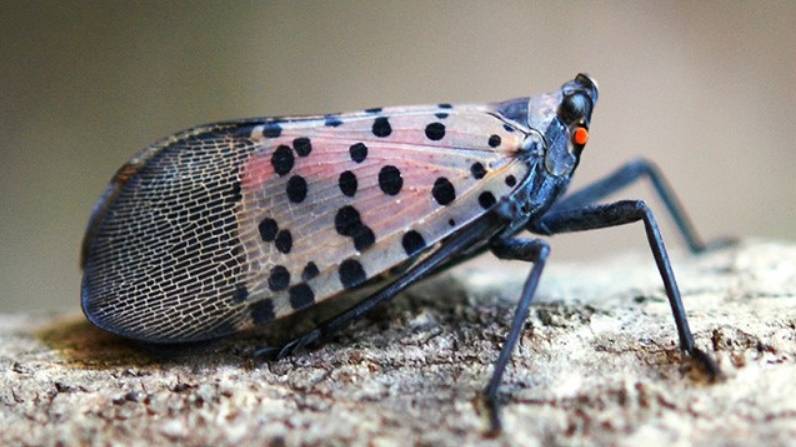
Spotted lanternfly has been confirmed in Canada.
The CFIA has established a regulated area in Ontario for SLF in the county of Essex, the city of Windsor, the township of Pelee and the municipality of Chatham-Kent.
Movement restrictions in this area are now in place to slow the spread of this pest and help protect non-infested areas in Canada. Under these regulations all things moving out of the regulated area to non-regulated areas must be free of all life stages of SLF.
Surveillance outside of the regulated area is ongoing.
Spotted lanternfly (Lycorma delicatula, Hemiptera: Fulgoridae) has been regulated in Canada since 2018. It can feed on more than 100 species of trees and plants, however, significant impacts from this feeding have only been observed on grapes.
More information on this and other pests can be found on the plant pest cards page.
What you can do
If you think you have seen the spotted lanternfly or its egg masses:
- take a photo or video
- catch the insect or scrape the egg masses and put it into a sealable container
- report it to us immediately:
- if it is outside of the regulated area of the county of Essex, city of Windsor, township of Pelee
- if it is within the regulated area of the municipality of Chatham-Kent (area adjacent to an established population)
- In other areas of Canada
- If you live within the regulated area:
- check your vehicles and items before leaving the regulated area – SLF can "hitchhike" and lay eggs on a variety of items
- make sure SLF is not hitching a ride by:
- killing them on sight – stomp or squish adults and nymphs immediately
- scraping the egg masses – into a sealable container and soak with soapy water or crush the egg masses completely ensuring nothing falls to the ground, as untouched eggs can still hatch
Report a spotted lanternfly sighting
The CFIA may contact you about the photo or video or if we need to collect the insect, as well as share details on how and when to dispose of it.
If you are travelling from infested areas of the U.S. or from the regulated area in Ontario, it is important to avoid accidentally transporting this pest with you. Be sure to check your vehicle and any items such as outdoor gear or equipment before leaving.
In your own area, inspect items stored outside for egg masses, including your vehicle and patio furniture. Look closely at things like tarps and sports equipment. Check your yard as well, as the SLF could be on your garden tools, trees and plants.
Help us by also reporting tree-of-heaven
Report sightings of the tree-of-heaven using the online app of your choice (for example: iNaturalist or EDDMapS). We are targeting locations of this tree to detect spotted lanternfly, as it is one of its preferred hosts.
Spot it: life stages of the spotted lanternfly
Spotted lanternfly egg masses are laid in late summer. These egg masses can survive winter temperatures and hatch in the spring. Find out what these stages look like, so you know what to look for.
-

Egg laying -

Egg mass -

Early stage nymph -

Late stage nymph -

Adult


Spotted lanternfly observations
Following the initial detection in Windsor, hundreds of confirmed spotted lanternfly observations were received across Essex County and we now consider there to be an established population of SLF in this area.
A regulated area has been established in the county of Essex, the city of Windsor, the township of Pelee and the municipality of Chatham-Kent, Ontario.
We continue to receive reports, directly and indirectly, of SLF observations in various locations across Canada. These reports help enhance monitoring and survey activities in areas where there have been sightings or interceptions.
Find out where these sightings have been.
How the spotted lanternfly could be introduced into Canada
There are many natural and human-assisted pathways by which the spotted lanternfly could be introduced into Canada.
Human-assisted spread can include:
- movement on cargo and containers
- camping gear and outdoor equipment
- patio furniture
- trucks and cars
- movement of plants and plant materials (including nursery plants, logs and firewood)
Don't forget to check anything you have stored outside while travelling to infested areas for the egg masses or the insect itself.
More information
- Printable infosheets: Spotted lanternfly
- Scientific fact sheet: Lycorma delicatula
- North American Plant Protection Organization (NAPPO) pest alerts
- United States Department of Agriculture – Animal and Plant Health Inspection Service: Spotted Lanternfly (including distribution information)
- Invasive Species Centre – Spotted lanternfly poster, factsheet and sentinel site signage
- RMD–22-03: Pest Risk Management Decision Document: Risk management for spotted lanternfly (Lycorma delicatula White)
- Plant pest surveillance
- D-24-01: Spotted lanternfly (Lycorma delicatula) – Domestic and import phytosanitary requirements
- Canadian Food Inspection Agency – Response framework for spotted lanternfly (Lycorma delicatula)