
The purpose of pedigreed seed crop inspection is to provide an unbiased inspection of a seed crop and complete a Seed Crop Inspection Report for the Canadian Seed Growers' Association (CSGA) on the isolation, condition and purity of the crop. It is the inspector's responsibility to describe the crop as observed at the time of inspection.
Updated: April 1, 2026
On this page
- 1.0 Scope
- 2.0 References
- 3.0 Definitions
- 4.0 Specific inspection procedures
- Appendices
- Appendix I: Soybean hilum colour
- Appendix II: Abscission layer
- Appendix III: Soybean characteristics and diagrams
- Appendix IV: Diseases that may influence soybean plant appearance
- Appendix V: Potential causes of green, immature plants
- Appendix VI: Pre-2016 and current colour descriptors used for soybean pubescence, pod and hilum colours
1.0 Scope
This Seed Program specific work instruction (SWI) outlines the procedures that a seed crop inspector will follow in inspecting soybean seed crops for pedigreed seed status. The seed crop inspection program ensures that seed crops grown for pedigreed status meet the requirements for varietal purity and seed crop standards as specified by the CSGA's Canadian Regulations and Procedures for Pedigreed Seed Crop Production (Circular 6).
These procedures apply to oilseed soybeans that are subject to variety registration under Part III of the Seeds Regulations. They also apply to varieties not subject to registration including miso, tofu, natto and vegetable types and high protein soybeans destined for roasting for livestock feed.
2.0 References
The publications referred to in this SWI are those identified in Seed Program Regulatory Authority Standard SPRA 101 - Definitions, acronyms and references for the seed program. In addition, the following were used in the development of this SWI:
- Modern Soybean Production, Scott, W.O. and Aldrich, S.R., S&A Publications Inc.
- Principles of Cultivar Development, Vol. 2, W.R. Fehr (ed.). 1987. Macmillan Publishing Co.
- Soya bean guidelines for the conduct of tests for distinctness, uniformity and stability TG/80/7. International Union for the Protection of New Varieties of Plants (UPOV). 2022. Geneva.
3.0 Definitions
For the purposes of this SWI the definitions given in SPRA 101 and the following apply:
- Abscission layer
- in soybeans, the layer of parenchyma cells formed at the point of attachment of the seed and the seed pod; as the parenchyma disintegrates, the seed becomes separated from the pod
- Bushy type
- soybeans with determinate growth type, 90 to 100 cm tall, drying more slowly than normal soybeans
- Determinate growth habit
- the terminal bud ceases vegetative activity when flowering begins
- Herbicide tolerant soybean variety
- a variety of soybeans that is tolerant of a herbicide for which tolerance is not ubiquitous throughout the traditional North American soybean gene pool
- Hilum colour
- the colour of the hilum or center spot on the seed can range from yellow, grey, brown or black (see appendix I); hilum colour and shape can be affected by plant maturity, environment and disease
- Indeterminate growth habit
- the terminal bud continues vegetative activity throughout the growing season
- Maturity
- for inspection purposes, maturity means that at least 90% of the plants in the inspected field have dropped their leaves. Soybean varieties are classified early, medium or late maturing
- Miso type soybean varieties
- soybean varieties which are fermented to make a paste with barley or rice malt
- Natto type soybean varieties
- small seeded soybeans varieties with high sugar content used for food purposes
- Pubescence colour
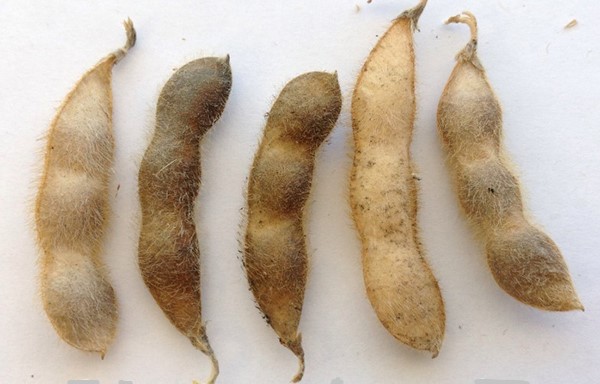
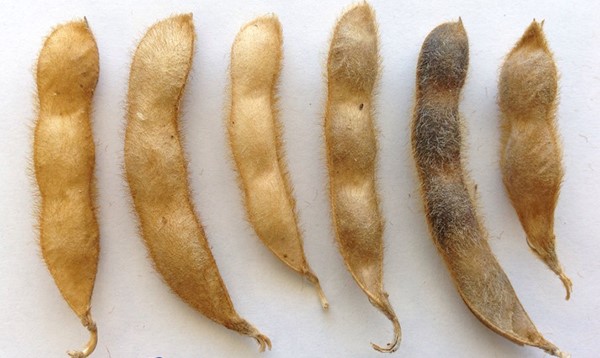
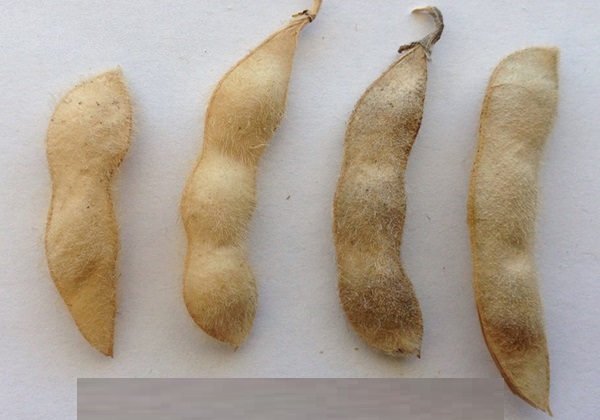
- colour of the short hairs on soybean plant stems and pods at maturity; the colour can be grey, light brown or brown and is best observed on the bottom 1/3 of the plant
- Semi-determinate growth habit
- the terminal bud continues vegetative growth after flowering but terminates this growth before indeterminate types
- Soybean kinds
- include oilseed, high protein, natto, tofu/soymilk, sprouting and miso
- Tofu type soybean varieties
- soybeans soaked and mashed to produce a curd
- Tall
- a plant can be considered tall when the top petiole is removed/absent and the main stem is approximately 15 cm above other main stems of the general plant population
4.0 Specific inspection procedures
Inspection of pedigreed seed crops of soybeans should be carried out as described in SWI 142.1.1 Pedigreed seed crop inspection, with the additional conditions and information provided in the following sections.
4.1 Inspection requirements
Seed crop inspection for soybeans must be made at maturity. As a general guide and based on harvest pressures, inspection could be conducted when a minimum of 90% of the plants have dropped all their leaves and the mature plants have developed distinguishing pod, pubescence and hilum colour characteristics.
Beginning in 2016, descriptors provided in the variety description for pubescence, mature pod and hilum colour follow a standardized colour scheme. See appendix VI. Only standardized colour descriptors for pubescence, mature pod and hilum may be reported.
Crop inspectors do not need to report plants as tall if they are shorter than the SWI definition (and otherwise conform) even if they are described in the variety description as variants.
4.2 Field inspection
The soybean is a highly self-pollinating crop with an outcrossing rate of less than 1% among fertile plants. In Canada, most soybean varieties have an indeterminate growth habit. Indeterminate varieties begin to flower when less than half of the nodes on the main stem have developed such that vegetative and reproductive development occur simultaneously for a considerable portion of the plant's life. Pod and seed development begin at the bottom of the plant and progress toward the top as new nodes form, but all seeds reach maturity at the same time.
When inspecting soybean seed crops, some key varietal characteristics at maturity are determined by colour and, therefore, it is important that light conditions for colour and contrast be maximized. This is important when determining off type characteristics such as pubescence and pod colour during inspection. The time of day, shadows, direction and the light angle may also be crucial.
Sometimes cloudy or overcast conditions allow for more contrast in colours and easier identification of variants and off-types than bright overhead sunlight. It should be noted that with the passing of time after maturity, the colour characteristics can be affected by weather and may not be as distinguishable. Pod colour at maturity can vary from light brown to black.
The following pictures demonstrate that a lighter pubescence colour can be deceiving and may make the pod colour appear lighter. Each picture shows examples of the same pod colour, but different pubescence colours.


Each of the following pictures shows examples of different pod colours, but the same pubescence colours.


Seed coat lustre can vary from dull to glossy. Soybean seed coat exists in a range of colours including yellow, green, brown, black and bicolour. The seed coat colour can be affected by environmental factors and diseases. When colour pigmentation, like black or brown, is present in the seed coat, it will be visible on all of the plant's seeds. In contrast, when the seed coat colour varies on the seed, the plant and from one plant to another, the seed coat colour variation is likely caused by a disease or frost.
Seed shapes may be round and spherical to elliptical and flattened. See appendix III.
While conducting counts, inspectors should open some pods to examine seed characteristics but are not expected to open pods from every plant. The focus should be on plants with another visible distinguishing characteristic that draws the inspector's attention to a possible off-type.
Other factors to watch for include maturity with later maturing plants often retaining their leaves and being taller than the other plants in the field (appendix V). The time of emergence, soil type, disease, herbicide injury and weather conditions can cause variability in plant height and maturity, making off-types for these factors difficult to distinguish at maturity. Plants that are immature due to environmental factors should not be included in counts. Appendix IV provides information on diseases that may alter the plant's appearance.
The following photo shows a portion of a field with many mature brown soybean plants without leaves and one immature green plant with many leaves.

Although the hilum colour is not fully developed in an immature plant, the developing colour may be helpful in determining if the plant will conform to the variety, for example, the colour is developing into a light versus a dark hilum. The following photo shows three immature soybeans with different hilum colours developing.

When reporting off-types and variants, the seed crop inspector must report two characteristics to describe the plant, or note "otherwise conforms" as the second characteristic.
Where the previous land use was soybean, particular attention should be paid to the possibility of volunteers.
Appendices
Appendix I: Soybean hilum colour
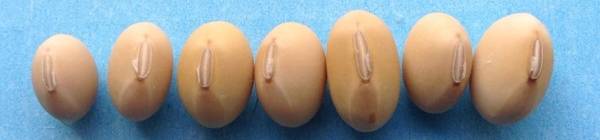
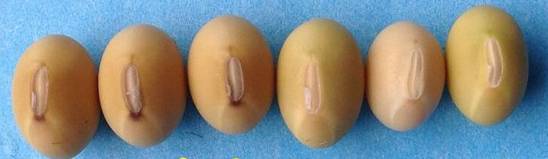
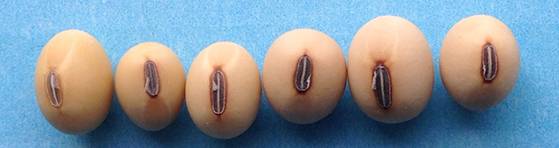
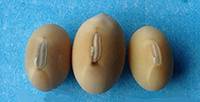
The following photo shows rows of soybeans seeds of each hilum colour option: black, imperfect black, dark brown, brown, grey, light brown, imperfect yellow and yellow.

Range of soybean hilum colours
Appendix II: Abscission layer
Lacking an abscission layer is a single gene trait in soybean. If the abscission layer between the seed and the seed pod is lacking, you cannot remove the adhering material from the seed easily. The adhering material can be polished off some seeds in a combine but in general it should be a constant trait in a variety. The description of the variety will characterize the abscission layer as lacking or normal. If a dash "-" is provided on the variety description, that indicates that the breeder has not provided information on this characteristic. The characteristic is considered stable when the abscission layer presents in the same way (lacking or normal) and not partially, on all the seeds in all the pods from the top to the bottom of the plant. If this is not the case, this characteristic is not stable and should not be used.
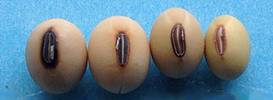
Each of the following two photos shows three seeds on the left where no material is attached (abscission layer is normal) and three seeds on the right with material clearly still attached to the seed (lacking abscission layer).


Appendix III: Soybean characteristics and diagrams
Distinguishing characteristics for identifying and reporting off-types in soybean:
- plant growth habit
- pubescence colour
- plant height
- pod colour
- seed shape
- seed coat colour
- hilum colour
- hilum size
- hilum abscission layer
Seed size may also indicate a different type of soybean, such as a natto-type soybean in an oilseed soybean field. These can also be reported as off-types.
Plant growth habit

erect

semi-erect

intermediate

semi-prostrate

prostrate
Seed shape
Seed shape is defined using ratios of the length, width and thickness as follows:
- spherical rounded (length/width, length/thickness and thickness/width ratios less than 1.2)
- spherical flattened (length/width ratio greater than 1.2; length/thickness ratio less than 1.2)
- elongate (length/thickness ratio greater than 1.2; thickness/width ratio less than 1.2)
- elongate flattened (length/thickness ratio greater than 1.2; thickness/width ratio greater than 1.2)
The following diagram identifies the length, width and thickness of a soybean seed.

length

width

thickness
The following photo shows four seed shapes (left to right): spherical rounded, spherical flattened, elongate and elongate flattened.

Appendix IV: Diseases that may influence soybean plant appearance
Plant is normal height but leaves are discoloured:
- anthracnose
- bacterial pustule
- downy mildew
Plants die prematurely/mature plants retain dead leaves:
- brown stem rot
- phytophthora root rot
- pod and stem blight
- sclerotia rot (also sclerotia bodies)
- stem canker
Pods and/or seeds abnormal in appearance:
- anthracnose
- downy mildew
- pod and stem blight
- purple seed stain
Plants stunted with crinkly or ruffled leaves:
- 2-4, D damage
- soybean mosaic virus (also streaks near the hila)
Appendix V: Potential causes of green, immature plants
Green, immature plants should not be assumed to be off-types. There can be many causes of green, immature plants as outlined in the chart below. The shaded column on the left contains titles of parts of the plant (leaves, stem, pods, seeds) or the plant population that are examined for identifying characteristics of the green, immature plant. The top shaded row contains titles of the causes of green, immature plants. Based on the described characteristics to identify environmental stress, green stem syndrome, male sterile, and bud blight, these plants should not be counted as off-types. Only off-types as described in the last column should be noted on the report.
| - | Environmental stress | Green stem syndrome | Male sterile | Bud blight | Off-type |
|---|---|---|---|---|---|
| Leaves | Green, present, can be diseased | None to present on upper nodes | Green | Green, leaflets may be smaller than normal and cupped | Green, 80% to 90% present |
| Stem | Green | Green | Green | May be stunted, brown discolouration of pith | Green |
| Pods | Present, immature | Mature, few to none | Largely absent, small on top of the plant | Developed poorly or aborted, may have brown patches | Present, immature |
| Seeds | Present, immature | Mature | 0 to 1 present in a pod | Few, if any | Present, immature |
| Plant population | Either plant population uniformly impacted by stress or a number of plants in certain locations | Distributed randomly or clustered in a field | Rare in population | Varies | Isolated individual plants |
Appendix VI: Pre-2016 and current colour descriptors used for soybean pubescence, pod and hilum colours
Standardized pubescence colour descriptors
The standardized pubescence colour descriptors are as follows:
- light brown
- brown
- grey
Soybeans with light brown pubescence are shown in the following image:
Soybeans with brown pubescence are shown in the following image:
Soybeans with grey pubescence are shown in the following image:
If non-standardized pubescence colour descriptors are encountered in a description of the variety, use the following chart to convert them to the closest acceptable colour descriptor.
| Pre-2016 pubescence colour descriptors | Convert to |
|---|---|
| tawny or brown tawny | brown |
| grey at top to tawny at bottom | brown |
| light tawny, very light tawny, very light brown or near grey | light brown |
| light tawny with some darker gold tawny | light brown |
| dark brown | brown |
Reminder - only the standardized pubescence colour descriptors can be used on the seed crop inspection report: light brown, brown and grey.
Some variety descriptions may have "additional information" indicating that the pubescence colour may appear different from what is specified in the description of variety (DOV). In these cases, the inspector does not need to flag the DOV or take plant samples to confirm the pubescence colour.
Standardized hilum colour descriptors
The standardized hilum colour descriptors are as follows:
- black
- imperfect black
- grey
- dark brown
- brown
- light brown
- imperfect yellow
- yellow
The following photo shows eight soybean seeds with different hilum colours labelled 1 to 8 to align with the standardized hilum colour descriptors.

If non-standardized hilum colour descriptors are encountered in a description of the variety, use the following chart to convert them to the closest acceptable colour descriptor.
| Pre-2016 hilum colour descriptors | Convert to |
|---|---|
| brownish black | brown or black |
| buff | light brown |
| dark buff | light brown or brown |
| grey to imperfect black with brown tint | imperfect black |
| light buff | light brown |
| light grey | grey |
| mid-light brown | light brown |
| tan | light brown |
| very light brown | light brown |
| clear | yellow |
| medium brown | brown |
Reminder - only the standardized hilum colour descriptors can be used on the seed crop inspection report: black, imperfect black, grey, dark brown, brown, light brown, imperfect yellow and yellow.
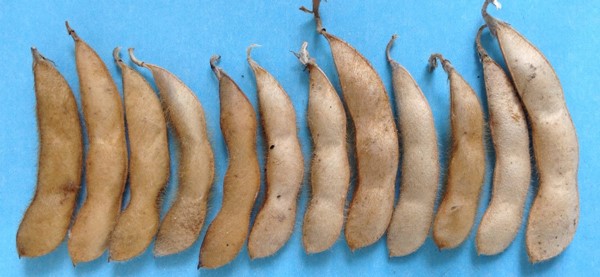
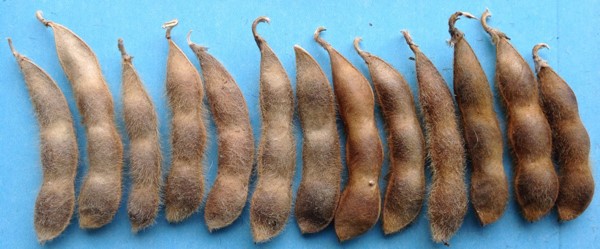
Standardized mature pod colour descriptors
The standardized mature pod colour descriptors are as follows:
- light brown
- brown to dark brown (a mix of brown-hued pods)
- black
When describing off-types with "brown to dark brown pods," inspectors should use the full descriptor if possible or they can write "brown pod" or "dark brown pod" if space is limited.
Soybeans with light brown pods will generally have a consistent light brown colour across the whole pod, as shown in the following photo.
Soybeans with brown to dark brown pods will generally have a slightly lighter colour on the portion of the pod in between the seeds, as shown in the following two photos.

Soybeans with black pods will generally have a consistent black colour across the whole pod, as shown in the following photo.

If non-standardized mature pod colour descriptors are encountered in a description of the variety, use the following chart to convert them to the closest acceptable colour descriptor.
| Pre-2016 mature pod colour descriptors | Convert to |
|---|---|
| tan | light brown |
| beige | light brown |
| mixed | light brown or brown to dark brown |
| pale tan | light brown |
Reminder - only the standardized pod colour descriptors can be used on the seed crop inspection report: light brown, brown to dark brown, and black.