
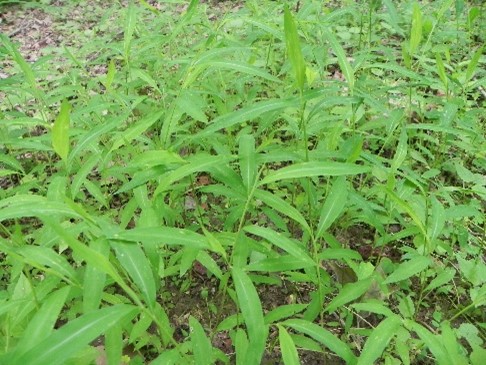
Japanese stiltgrass (Microstegium vimineum) is a shade-tolerant plant of the grass family (Poaceae). It can spread quickly and form dense patches. Japanese stiltgrass disrupts ecosystems by outcompeting native plants, obstructing forest regeneration, changing soil chemistry, and impacting habitats for birds and other wildlife.
Report a Japanese stiltgrass sighting
Where it's found
In Canada, Japanese stiltgrass has been found in a few locations in southern Ontario. Known sites are currently under official control.
Japanese stiltgrass is native to temperate and tropical regions of Asia. It has been introduced in many countries around the world, including the United States. It can be found in many habitats, including forests, parks, pastures, wetlands, and disturbed areas such as roadsides and trails.
How to spot it
-

Leaves -

Leaves -

Foliage (fall) -

Inflorescence -

Leaf attachment and stem -

Grain and spikelets
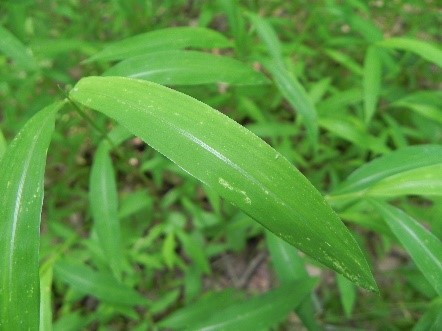
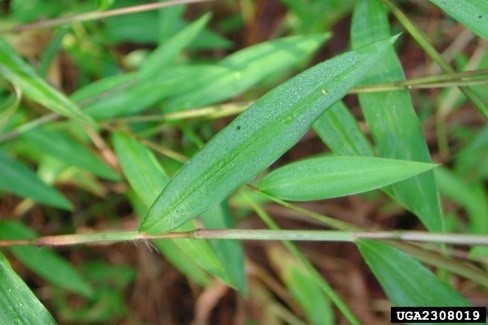
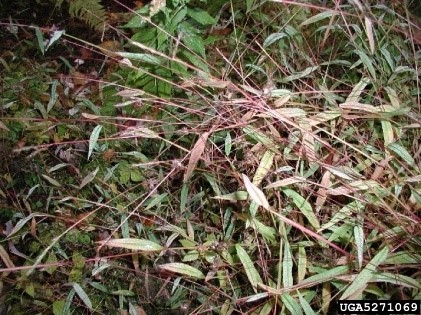
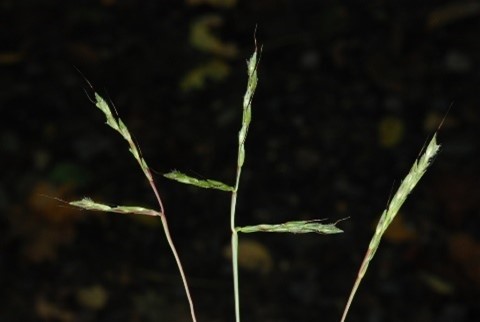
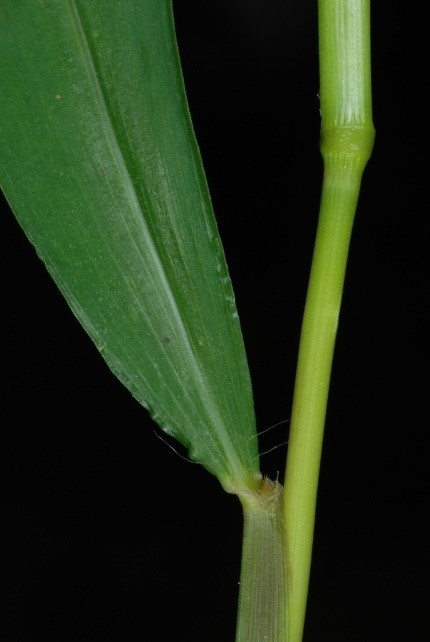
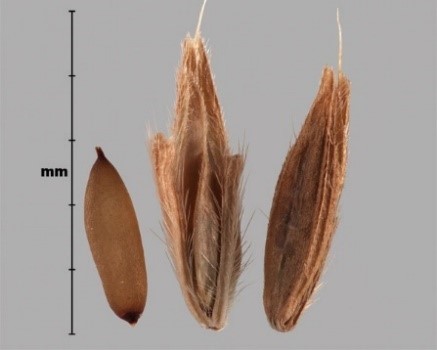
Japanese stiltgrass is an annual plant with a sprawling growth habit. Stems grow up to 1 m long and have many branches. Leaf blades are linear-elliptic, pale green, tapered at both ends and have a light-coloured stripe in the centre. The inflorescence may be divided into one to several individual clusters that are each up to 9 cm long. Spikelets are awned and bristly. Plants develop a slightly purplish colour in autumn.
How it spreads
Japanese stiltgrass spreads primarily by seeds, which can survive in the soil for many years. Seeds can attach to clothing or animal fur. They can also be found on muddy car tires and shoes. Bird seed, soil, nursery stock and hay can also be contaminated with Japanese stiltgrass. Once established in an area, the plants also spread locally by rooting at nodes along the stem.
What you can do
- Stay on designated pathways and trails
- Brush off clothing and clean footwear to avoid spreading seeds and plant material
- Ensure machinery, vehicles and tools are free of soil and plant parts before moving them from one area to another
- Leave natural items in their natural habitats
- Do not dump garden waste in parks, fields, forests or other natural areas
- If you think you've spotted Japanese stiltgrass, report it to the Canadian Food Inspection Agency (CFIA). The CFIA will follow up and determine if further action is needed.
What we are doing
Japanese stiltgrass is regulated as a pest in Canada under the Plant Protection Act. Importation and domestic movement of regulated plants and their propagative parts is prohibited.
- RMD-13-04: Consolidated Pest Risk Management Document for pest plants regulated by Canada
- D-12-01 Phytosanitary Requirements to Prevent the Introduction of Plants Regulated as Pests in Canada