

Multinucleate sphere unknown (MSX) and perkinsosis (Dermo) in oysters
In Canada, multinucleate sphere unknown (MSX) and perkinsosis (also known as Dermo) are federally reportable diseases. All suspected cases must be reported to us.
On September 2, 2025, these waters were declared as areas where the aquatic animal diseases MSX and Dermo are present or very likely to be present:
- Prince Edward Island
- New Brunswick
- Nova Scotia
- Newfoundland and Labrador
- Québec
Follow biosecurity guidance to prevent the spread of disease from declared areas to other locations within Canada.
MSX and Dermo are not food safety concerns.
On this page
- Latest situation
- Map of the declared areas in eastern Canada
- CFIA permits under the Domestic Movement Control Program
- Application forms
- Other movement controls/permits for declared areas
- Contact us
- Related links
Latest situation
We are responding to the presence of MSX and/or Dermo in oysters collected in Canada.
- Statement – New movement controls and updated declaration status for oyster diseases in eastern Canada
2025-09-02 - Statement – Detections of MSX and Dermo in oysters in Quebec
2025-07-04 - Statement – Detection of Dermo in oysters in Prince Edward Island
2025-07-04 - Statement – Detection of Dermo in oysters in Newfoundland and Labrador
2025-06-05 - Joint statement – New oyster movement rules in Prince Edward Island to help prevent further spread of MSX
2025-02-03 - Joint Statement – Detection of Dermo in oysters in Nova Scotia
2024-11-27 - Joint Statement – Detection of MSX and Dermo disease in oysters in New Brunswick
2024-11-21 - Joint Statement – Additional Detections of MSX in Prince Edward Island
2024-07-24 - Joint Statement – Detection of MSX in Bedeque Bay, Prince Edward Island
2024-07-13
Map of the declared areas in eastern Canada
Movement controls for MSX and Dermo in eastern Canada are now made through the aquatic animal Domestic Movement Control Program (DMCP).
Last updated: 2025-09-18
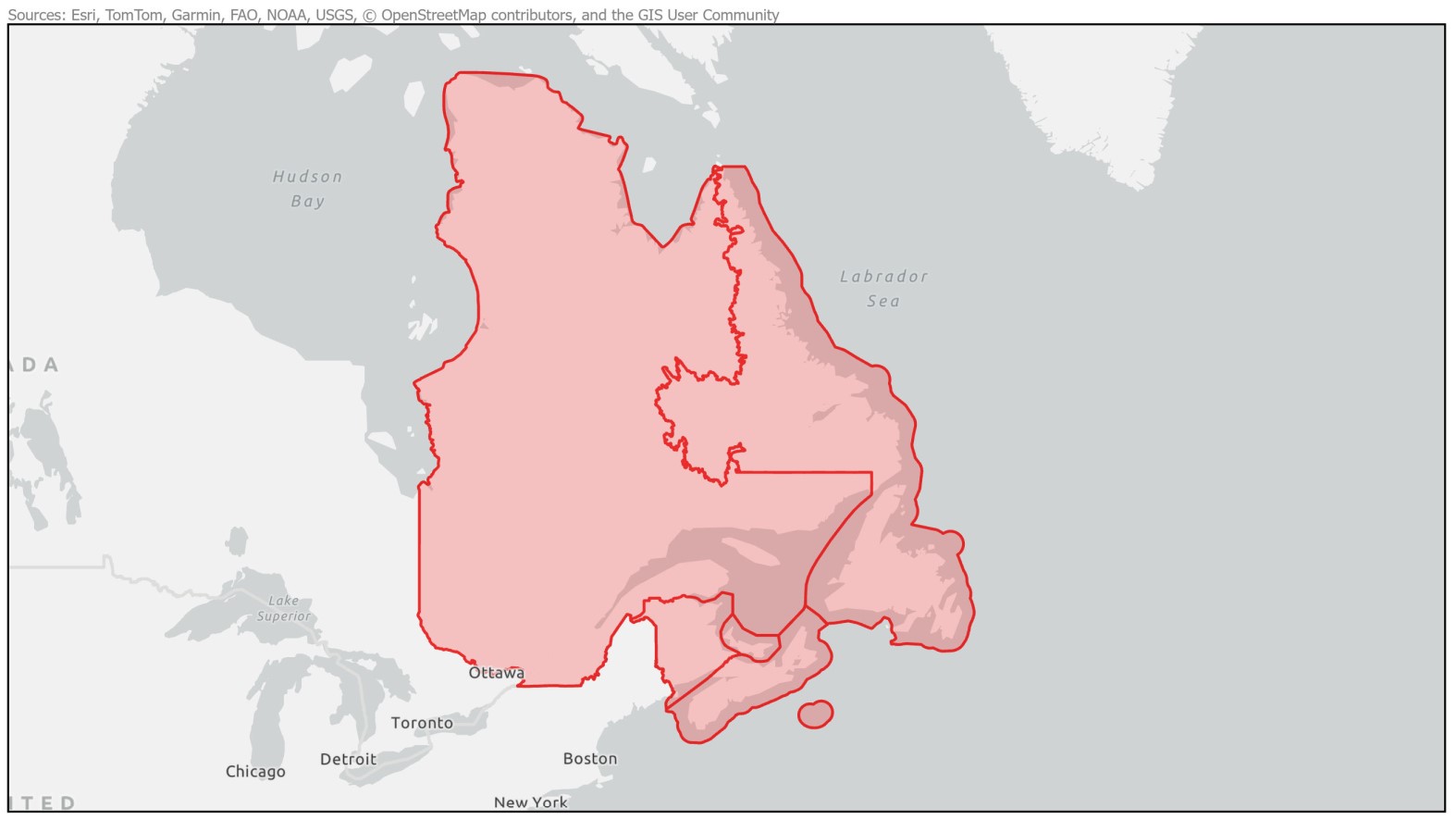
Description for the area identified as eastern Canada
Map of eastern Canada showing declared infected areas for MSX and Dermo diseases in oysters. The infected areas are shaded in solid red with a red outline. The shaded region includes all of Quebec, the Gulf of St. Lawrence, and the Îles-de-la-Madeleine, and extends into parts of New Brunswick, Nova Scotia, Prince Edward Island, and Newfoundland and Labrador.
CFIA permits under the Domestic Movement Control Program
Moving to the Domestic Movement Control Program (DMCP) for MSX and Dermo simplifies the permitting process for oyster growers, harvesters and processors within a declared area. For declared areas, CFIA permits are not required for movement of oysters or gear within the declared infected area.
You must get a CFIA DMCP permit before moving oysters, spat or gear out of a declared area (that is, Prince Edward Island, New Brunswick, Nova Scotia, Newfoundland and Labrador and Québec) to an area of better health status.
More information is available on the Aquatic animal domestic movements page.
Application forms
Follow these steps to apply for a domestic movement permit:
- Before completing the application:
- review the declarations of reportable disease status
- contact the CFIA Area Office or our support line to ensure that a permit is required for the aquatic animal or thing to be moved
- review additional information, including the permit conditions, in the industry guidance documents for laboratories, researchers, finfish culturists and mollusc culturists
- Complete the following application to move molluscs or declared things:
- Submit the application
- send the completed application by email, fax or regular mail to our National Centre of Permissions (contact information is on the application form)
Sign up for email notifications to receive important updates on this program.
Other movement controls/permits for declared areas
Fisheries and Oceans Canada (DFO) continues to manage oyster movements within and between provinces through the Introductions and Transfer (I&T) licensing program, in collaboration with the respective provincial authority and, when appropriate, in consultation with the CFIA.
For questions related to the Introductions and Transfers licensing program, contact the DFO Introductions and Transfers Committee for your province.
Contact us
For more information, contact your local CFIA Animal Health Office.
Related links
- Facts about MSX (disease caused by Haplosporidium nelsoni)
- Facts about Dermo (disease caused by Perkinsus marinus)
- Aquatic animal health: Notices to industry
- National Aquatic Animal Health Program
- Mollusc Reportable Diseases: Declarations by Province and Marine Area