
ISSN: 2819-0270
On this page
- 1. Introduction
- 2. Highlights of fiscal quarter and fiscal year-to-date (YTD) Result
- 3. Risks and uncertainties
- 4. Significant changes in relation to operations, personnel and programs
- Annex A – Statement of authorities (unaudited)
- Annex B – Departmental budgetary expenditures by standard object (unaudited)
1. Introduction
This quarterly report (Q3) has been prepared by management as required by section 65.1 of the Financial Administration Act and in the form and manner prescribed by the Treasury Board. This quarterly report should be read in conjunction with the 2025 to 2026 Main Estimates, the 2025 to 2026 Supplementary Estimates and authorities received from Treasury Board central votes. Main and Supplementary Estimates documents can be found on the Government of Canada's planned government spending webpage.
A summary description of the program activities of the Canadian Food Inspection Agency (CFIA) can be found in the CFIA's 2025 to 2026 Departmental Plan.
This quarterly report has not been subject to an external audit or review.
1.1 CFIA mandate
The Minister of Health is responsible for the CFIA and for the overall direction of the agency. In addition, the Minister of Agriculture and Agri-Food is responsible for oversight of the agency's non-food safety agricultural activities, including economic and trade issues, as well as important animal health and plant protection work.
The CFIA is headed by a President, who has the rank and all the powers of a Deputy Head of a Department. The President is also the Chief Executive Officer. The responsibilities of these roles are outlined in the Canadian Food Inspection Agency Act 1997, c.6.
Mitigating risks to food safety is the CFIA's highest priority, and the health and safety of Canadians is the driving force behind the design and development of CFIA programs. The CFIA, in collaboration and partnership with industry, consumers, and federal, provincial and municipal organizations, and, international counterparts, continues to work towards protecting Canadians from preventable health risks related to food and zoonotic diseases.
In collaboration with its partners in Canada and abroad, the CFIA is applying a One Health approach to many issues encompassed by its mandate. The One Health approach recognizes the interconnectedness of the health of humans, animals, plants, and the environment and that efforts to address serious global health issues benefit from strong coordination and collaboration between professionals in these fields. The one Health approach also benefits from shared resources and investments.
1.2 Basis of presentation
This quarterly report has been prepared by management using an expenditure basis of accounting. The accompanying Statement of Authorities (Annex A) includes the agency's spending authorities granted by Parliament and those used by the agency, consistent with the supplies granted for the 2025 to 2026 Main Estimates, the 2025 to 2026 Supplementary Estimates and authorities received from Treasury Board central votes. This quarterly report has been prepared using a special purpose financial reporting framework designed to meet financial information needs with respect to the use of spending authorities.
The authority of Parliament is required before funding can be spent by the Government. Approvals are given through annual appropriation acts or legislation which provides statutory spending authority for specific purposes. The CFIA was granted its full supply for the 2025 to 2026 fiscal year in June 2025.
The agency uses the full accrual method of accounting to prepare and present its annual financial statements that are part of the departmental results reporting process. However, the spending authorities voted by Parliament remain on an expenditure basis.
2. Highlights of fiscal quarter and fiscal year-to-date (YTD) Result
In line with previously reported variances in the Departmental Results Report and Quarterly Financial Reports, the CFIA has determined that variances which are greater than $5.0 million and represent more than a 10% change, in budget or expenditures from one year to the next, are deemed significant. When both criteria are met, further analysis is always provided. Further analysis is also provided when the dollar value is deemed significant.
The following graph provides a comparison of total budgetary authorities available for spending and year-to-date expenditures for the third quarter of the current and previous fiscal years.
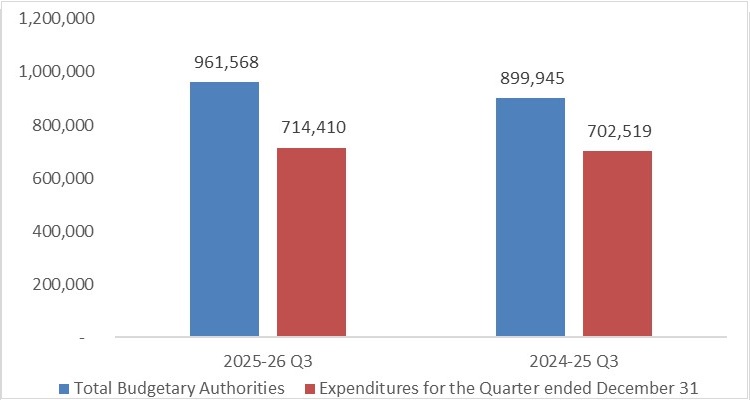
Graph 1. Comparison of total budgetary authorities and expenditures for the quarter ended December 31 for fiscal years 2025 to 2026 and 2024 to 2025 (in thousands of dollars) – Text version
| Quarter ended December 31 | 2025 to 2026 | 2024 to 2025 |
|---|---|---|
| Total budgetary authorities | 961,568 | 899,945 |
| Expenditures for the quarter ended December 31 | 714,410 | 702,519 |
2.1 Significant changes to budgetary authorities
At the end of the third quarter, December 31, 2025 (Q3), the CFIA had $961.6 million of authorities available for spending, as detailed in Table 1. This represents an overall increase of $61.6 million (6.8%) compared to the end of the same quarter in 2024 to 2025. Below is a breakdown of the variance.
| Authorities | 2025 to 2026 | 2024 to 2025 | Variances | % |
|---|---|---|---|---|
| Vote 1 – Operating expenditures, grants, and contributions | 768,784 | 706,504 | 62,280 | 8.8 |
| Vote 5 – Capital expenditures | 31,488 | 45,700 | −14,212 | −31.1 |
| Budgetary statutory authorities | ||||
| Employee benefit plans | 95,796 | 82,241 | 13,555 | 16.5 |
| Compensation payments | 12,500 | 12,500 | 0 | 0.0 |
| Spending of revenues / Other | 53,000 | 53,000 | 0 | 0.0 |
| Total authorities | 961,568 | 899,945 | 61,623 | 6.8 |
|
Numbers may not add due to rounding. |
||||
The Vote 1 – Operating expenditures, grants, and contributions authorities increased by $62.3 million (8.8%) due to the net effect of the following items:
- An increase of $32.1 million for Collective Bargaining Agreement settlements.
- An increase of $25.3 million in funding to support rapid response measures to protect human and animal health from avian influenza (H5N1).
- An increase of $17.5 million to mitigate the public health, animal health and economic risks related to Bovine Spongiform Encephalopathy (BSE).
- An increase of $4.8 million in funding for the Canadian Shellfish Sanitation Program.
These increases in authorities are partially offset by:
- A reduction of $15.0 million for the sunsetting of funding to build a post pandemic agile workforce and to support long-term digital transformation (Covid Pivot); and
- A decrease of $4.7 million for Refocusing Government Spending.
The Vote 5 – Capital expenditures authorities available for spending decreased by $14.2 million (−31.1%) mainly due to the year-over-year variance in funding to build the new Sidney Centre for Plant Health.
The Employee Benefit Plans (EBP) increase of $13.6 million (16.5%) can be explained by a variation in the EBP rate set by the Treasury Board Secretariat, and additional costs related to Collective Bargaining Agreement settlements.
The fluctuations in authorities available for spending are most notable in the following standard objects (see Annex B for the full listing of budgetary authorities by standard object):
- Personnel: an increase of $46.2 million (6.7%) is mainly due to collective bargaining agreement settlements, EBP, and the net effect of the year-over-year variance in funding for the H5N1 response, BSE, Covid Pivot, and the Refocusing Government Spending initiative.
- Professional and special services: an increase of $13.3 million (15.1%) is mainly due to the net effect of the year-over-year variance in funding for the H5N1 response, BSE, and Covid Pivot.
- Acquisition of machinery and equipment: a decrease of $11.1 million (−35.7%) is due to the net effect of the year-over-year variance in funding for the new Sidney Center for Plant Health.
- Utilities, materials and supplies: an increase of $7.3 million (26.5%) is mainly associated with funding for the H5N1 response.
- Transportation and communications: an increase of $6.3 million (119.8%) is largely related to funding for the H5N1 response.
2.2 Significant changes in year-to-date expenditures
At the end of the third quarter for the 2025 to 2026 fiscal year, the CFIA has expenditures of $714.4 million as outlined in Table 2. This represents an overall increase of $11.9 million (1.7%) compared to the end of the same quarter for the 2024 to 2025 fiscal year. Below is a breakdown of the variance.
| Expenditures | 2025 to 2026 | 2024 to 2025 | Variances | % |
|---|---|---|---|---|
| Vote 1 – Operating expenditures, grants, and contributions | 513,797 | 501,102 | 12,695 | 2.5 |
| Vote 5 – Capital expenditures | 10,605 | 34,154 | −23,549 | −68.9 |
| Budgetary statutory authorities | ||||
| Employee benefit plans | 71,684 | 60,810 | 10,874 | 17.9 |
| Compensation payments | 75,408 | 44,548 | 30,860 | 69.3 |
| Spending of revenues / Other | 42,916 | 61,905 | −18,989 | −30.7 |
| Total expenditures | 714,410 | 702,519 | 11,891 | 1.7 |
|
Numbers may not add due to rounding. |
||||
Compared to the same quarter in the previous year, the Q3 Operating expenditures (Vote 1) increased by 12.7 million (2.5%) mainly due to a timing difference in the number of pay periods in the third quarter.
Capital expenditures (Vote 5) as at the end of Q3 decreased by $23.5 million (−68.9%) year-over-year mainly due to reduced expenditures for the new Sidney Center for Plant Health.
EBP increased by $10.9 million (17.9%) mainly due to Collective Bargaining Agreement settlements, and a higher EBP rate in 2025 to 2026.
Compensation payments as at the end of Q3 increased by $30.9 million (69.3%) year-over-year mainly due to an increase in compensation payment costs for HPAI ($25.0 million) and tuberculosis ($7.4 million). This was offset by fewer payments for potato wart (-$2.0 million). Since compensation payments are statutory in nature, the Agency is within its authority to incur expenditures as required. These authorities will be adjusted at year-end to the equivalent of all expenditures related to compensation payments.
Spending of revenues has decreased by $19.0 million (−30.7%) as compared to the same quarter in 2024 to 2025 mainly due to reduced expenditures for the new Sidney Center for Plant Health.
Compared to the same reporting period in 2024 to 2025, the fluctuations in expenditures year-to-date are most notable in the following standard objects (see Annex B for the full listing of budgetary expenditures by standard object):
- Professional and Special Services: a decrease of $37.1 million (−45.9%) is mainly due to reduced expenditures associated with the construction of the new Sidney Centre for Plant Health.
- Transfer Payments: an increase of $30.5 million (67.4%) is mainly due to higher payments for HPAI and tuberculosis.
- Personnel: an increase of $18.2 million (3.4%) is mainly due to a timing difference in the number of pay periods in the third quarter and a higher EBP rate.
3. Risks and uncertainties
The Agency operates in a dynamic and complex environment impacted by interconnected risks in the global trading environment, climate change, and multiple concurrent emergencies. The Agency has established a dedicated emergency reserve to manage the incremental response costs associated with emergencies. This is reviewed every year as part of the Agency's planning process and is subject to ongoing monitoring.
Global trade, climate change, and associated factors (including environmental degradation, natural disasters, and warming global temperatures) have increased the frequency and scale of serious animal diseases and plant pests worldwide. As a result, there is a growing likelihood that the CFIA will be required to respond to more frequent and widespread outbreaks of diseases. Key threats include plant pests like spotted lanternfly and emerald ash borer, and animal diseases like African Swine Fever (ASF) and Food and Mouth Disease (FMD). Animal diseases that pose risks to human health include dog rabies and prion diseases such as chronic wasting disease. The CFIA also continues to manage a multi-year HPAI outbreak affecting poultry, wildlife, and domestic mammals and people, and potential interspecies transmission and broader economic and public health impacts. Individually or concurrently, such emergencies could strain CFIA's capacity to deliver essential services. In response to these risks, the CFIA has advanced its climate change adaptation efforts by implementing targeted measures to strengthen system resilience, while supporting Canada's transition to a sustainable, secure agri-food system.
As the lead authority for safeguarding Canada's food system and the plant and animal resources on which we depend to support the Canadian economy through the trade of Canadian goods, the Agency must respond with prompt action above and beyond normal business activities when these temporary situations arise. These actions are essential to safeguard Canadians with respect to importing foods and maintaining or gaining access to export markets. Shifts in the global trade environment arising from factors such as supply chain disruptions and increased prevalence of animal and plant diseases and plant pests may pose risks not only to Canada's economy and its ability to expand market access and support trade, but also to the integrity of its food safety system. Responses to these types of scenarios could result in the implementation of various strategies to prevent market disruptions, safeguard trade continuity and challenge the CFIA's ability to maintain critical operations. To navigate shifting global trade dynamics, the CFIA has enhanced international engagement by collaborating with international food safety authorities and supported market access, helping Canada's agri-food sectors remain resilient, competitive and responsive to both export and import challenges.
4. Significant changes in relation to operations, personnel, and programs
4.1 Personnel
- Dr. Raman Srivastava has been appointed a dual role as Vice-President, Human Resources and Digital Services, effective October 13, 2025
- Scott Rattray has been appointed a dual role as the Inspector General and Chief Audit Executive of the CFIA, effective November 3, 2025
Approved by:
Paul MacKinnon
President, CFIA
Stanley Xu, CPA, CGA
Vice-President, Corporate Management Branch and Chief Financial Officer, CFIA
Ottawa (Ontario)
Date: February 27, 2026
Ottawa (Ontario)
Date: February 27, 2026
Annex A – Statement of authorities (unaudited)
| Budgetary Authorities | Fiscal year 2025 to 2026 | Fiscal year 2024 to 2025 | ||||
|---|---|---|---|---|---|---|
| Total available for use for the year ending March 31, 2026Table note 1 | Used during the quarter ended December 31, 2025 | Year to date used at quarter-end | Total available for use for the year ending March 31, 2025Table note 1 | Used during the quarter ended December 31, 2024 | Year to date used at quarter-end | |
| Vote 1 – Operating expenditures, grants, and contributions | 768,784 | 180,255 | 513,797 | 706,504 | 168,670 | 501,102 |
| Vote 5 – Capital expenditures | 31,488 | 4,400 | 10,605 | 45,700 | (3,632) | 34,154 |
| Budgetary statutory authorities | ||||||
| Employee benefit plans | 95,796 | 23,895 | 71,684 | 82,241 | 20,270 | 60,810 |
| Compensation payments | 12,500 | 34,600 | 75,408 | 12,500 | 12,054 | 44,548 |
| Spending of revenues | 53,000 | 19,180 | 42,890 | 53,000 | 38,319 | 61,870 |
| Refunds of previous years revenue | 0 | 8 | 20 | 0 | 0 | 18 |
| Collection agency fees | 0 | 0 | 0 | 0 | 0 | 0 |
| Spending of proceeds from the disposal of surplus Crown assets | 0 | 6 | 6 | 0 | 16 | 17 |
| Total budgetary authority | 961,568 | 262,344 | 714,410 | 899,945 | 235,697 | 702,519 |
| Numbers may not add due to rounding. | ||||||
Annex B – Departmental budgetary expenditures by standard object (unaudited)
| Standard Object | Fiscal year 2025 to 2026 | Fiscal year 2024 to 2025 | ||||
|---|---|---|---|---|---|---|
| Total available for use for the year ending March 31, 2026Table note 1 | Used during the quarter ended December 31, 2025 | Year to date used at quarter-end | Total available for use for the year ending March 31, 2025Table note 1 | Used during the quarter ended December 31, 2024 | Year to date used at quarter-end | |
| Expenditures | ||||||
| Personnel | 735,653 | 188,047 | 552,091 | 689,409 | 176,065 | 533,894 |
| Transportation and communications | 11,563 | 3,595 | 6,897 | 5,262 | 2,989 | 6,842 |
| Information | 13,061 | 590 | 2,471 | 12,377 | 714 | 2,979 |
| Professional and special services | 101,511 | 19,727 | 43,666 | 88,172 | 27,175 | 80,732 |
| Rentals | 16,230 | 3,195 | 6,092 | 16,833 | 1,798 | 2,739 |
| Repair and maintenance | 12,868 | 2,078 | 6,565 | 11,830 | 3,006 | 6,398 |
| Utilities, materials and supplies | 34,946 | 4,980 | 11,530 | 27,624 | 4,396 | 11,062 |
| Acquisition of land, buildings and works | 0 | 0 | 0 | 0 | 0 | 0 |
| Acquisition of machinery and equipment | 20,019 | 2,748 | 5,836 | 31,138 | 3,514 | 9,389 |
| Transfer payments | 13,100 | 34,600 | 75,700 | 14,683 | 12,494 | 45,210 |
| Public debt charges | 0 | 0 | 0 | 0 | 0 | 0 |
| Other subsidies and payments | 2,617 | 2,784 | 3,562 | 2,617 | 3,546 | 3,274 |
| Total gross budgetary expenditures | 961,568 | 262,344 | 714,410 | 899,945 | 235,697 | 702,519 |
| Numbers may not add due to rounding. | ||||||