
Consultation: January 26, 2026 – February 24, 2026
On this page
- 1.0 Legislative authority
- 2.0 Definitions, abbreviations and acronyms
- 3.0 Introduction
- 4.0 Scope
- 5.0 Roles and responsibilities
- 6.0 Legislative requirements to maintain biosecurity and record keeping
- 7.0 BRR related requirements for established seed potato grower and field grown seed potatoes
- 8.0 Investigation procedures
- 9.0 BRR-related requirements for new seed potato growers and farms re-entering the CSPCP
- 9.1 Cleaning and disinfection requirements
- 9.2 Management of volunteer potatoes in a field with BRR
- 9.3. Application process
- 9.4 BRR testing for new growers
- 9.5 Enhanced sampling program for growers requesting to re-enter the CSPCP
- 9.6 Issuance of tags and records of bulk movement during the first 3 years after a BRR detection
- 9.7 Return to certification
- Appendix 1: Roles and responsibilities
- Appendix 2: BRR monitoring program - Sample size
- Appendix 3: Sampling procedures for seed potato growers
- Appendix 4 Sampling rates during a BRR investigation
- Appendix 5: Flow charts for BRR testing once it has been detected on a seed potato farm unit
- Appendix 6: Summary requirements
- Appendix 7: Enhanced sampling rates
This directive sets out the Bacterial Ring Rot (BRR) requirements for producing field-grown seed potatoes on farm units participating in the Canadian Seed Potato Certification Program (CSPCP).
It also outlines:
- mandatory biosecurity measures
- sampling and testing protocols
- requirements for new seed potato farms
- BRR investigation procedures
- farms re-entering the program after a BRR detection
This directive supersedes D-97-12: Seed Potato Certification Program – Bacterial Ring Rot Testing Program for Field Grown Seed Potatoes (5th Revision) and D-95-18: Seed Potato Certification Program - Investigation Procedure after Clavibacter michiganensis Subsp. sepedonicus has been detected on a Seed Potato Farming Unit (4th Revision).
1.0 Legislative authority
- Access to Information Act
- Seeds Act
- Seeds Regulations
2.0 Definitions, abbreviations and acronyms
Definitions for terms used in the present document can be found in the Seeds Regulations, Plant health glossary of terms or as defined in this section:
- Crop
- means breeder's selection seed potatoes or a variety and class of seed potatoes, growing in an aseptic environment, a protected environment or in 1 or more fields of a farm unit.
- Index farm
- means the seed potato farm unit where a regulated pest or disease, such as BRR, has been confirmed.
- Lot
- means the quantity of harvested seed potatoes of a variety and class that is identifiable by 1 certificate number or the quantity of breeder's selection seed potatoes that are identifiable by 1 certificate number.
- Non-certified potatoes
- means potatoes that do not meet the standards for any of the classes established in Seeds Regulations Part II or seed potatoes that have been transported without required certification documents (for example, seed potato tags or certificate of authorization).
- Seed source (parent) farm unit
- means the seed potato farm unit from which seed potato lots originated in the previous year and were supplied for planting.
- Sister lot
- means the lots of seed potatoes that originated from a common seed source.
- Trace-back investigation
- an investigation conducted to identify seed potato source farm units that may have provided seed potato lots to the index farm unit or that may have used common equipment or storage facilities associated with an index farm unit.
- Trace-out investigation
- means an investigation conducted to identify seed potato farm units that may have received seed potato lots from an index farm or used common equipment or storage.
- Volunteer potato tuber
- means a potato tuber that has overwintered from a previous crop and subsequently grows into a potato plant in the following growing season, with the potential to develop additional tubers.
3.0 Introduction
Clavibacter sepedonicus, the causal agent of BRR, is 1 of the most destructive bacterial pathogens affecting seed potato production. Its presence in a seed lot can result in:
- severe economic losses
- regulatory restrictions
- long-term damage
Under the Seeds Regulations Part II, there is zero tolerance for this pest on a seed potato farm unit. A mandatory laboratory testing program is in place to maintain the health status of Canadian seed potato stocks.
BRR can persist in a field or farm unit through:
- contaminated equipment
- storage facilities
- infected volunteer potato plants
The bacterium survives as a dried biofilm on surfaces for extended periods and can spread via:
- physical contact during planting
- harvesting
- handling
Volunteer potato plants emerging in previously infected fields pose a significant risk of reintroducing the pathogen and compromising disease-free status. Measures to prevent recurrence and ensure compliance with seed certification standards include:
- rigorous cleaning
- disinfection of all equipment and facilities
- proactive volunteer potato plant management
This directive explains the requirements related to BRR in the Seeds Regulations Part II including the requirements for new seed potato growers and for those seeking to regain access to the program on farm units where BRR has been detected. The requirements described apply to all lots and crops on the farm unit, including those not entered for certification or those rejected from certification.
For effective disease control and potential eradication, follow-up actions are required once there is a detection in seed or non-seed potatoes produced on a seed potato farm unit. Each case must be:
- investigated to contain infected lots
- identify the source of infection
- prevent further spread to other seed potato farms
Investigative actions beyond seed potato farm units participating in the program fall outside the CFIA's legislated mandate and may be carried out by provincial authorities or growers' associations, depending on their respective mandates.
The Seeds Regulations Part II also requires specific BRR testing for nuclear stock class material and its equivalent. The plant health policies regarding these are covered in 2 other directives:
- D-97-08: "Production, Maintenance, Multiplication, and Certification of Nuclear Stock Seed Potatoes"
- D-97-11: "Seed Potato Certification Program - Requirements for the production of Pre-Elite seed potatoes from sources other than Nuclear Stock"
The requirements for BRR and imported seed potatoes from the United States are contained in CFIA directive D-98-01.
4.0 Scope
This directive is intended for use by:
- CFIA inspection and laboratory staff
- CFIA-approved laboratories
- grower associations
- seed potato growers
It explains:
- roles and responsibilities of growers
- biosecurity measures and testing requirements
- the investigative actions to be followed upon detection
4.1 Regulated pests
Clavibacter sepedonicus, the pathogen causing Bacterial Ring Rot in potatoes.
4.2 Regulated articles
- field-grown seed potatoes (Solanum tuberosum)
- all non-certified potatoes on a seed potato farm unit
- equipment, storage and vehicles used to produce seed potatoes
5.0 Roles and responsibilities
Roles and responsibilities for the CFIA and seed potato growers are aligned with the Seeds Regulations Part II and are summarized in appendix 1.
5.1 Grower's duty to provide reasonable assistance
Providing reasonable assistance to the CFIA is required for:
- informing the inspector of the status and location of all lots including the location of lots stored elsewhere
- collecting samples
- providing access to all storages including boxes and bins
- providing all records related to the investigation, including records of cleaning and disinfection
- providing records to trace the movement of all potatoes from the farm unit under investigation
- moving all boxes in a storage to provide an inspector access to all boxed lots for sampling
- if a lot of potatoes is stored in a bin behind another lot, informing the inspector of the first opportunity when the lot will be accessible and coordinating with the inspector to provide access to the lot
6.0 Legislative requirements to maintain biosecurity and record keeping
Information on the biosecurity measures required to maintain seed potato crop certification, with particular emphasis on sanitation practices to prevent the introduction and spread of BRR within farm units. Given the highly infectious nature of BRR and the difficulty of eradicating the pathogen once established, strict biosecurity measures are essential.
The CFIA in collaboration with:
- producer organizations
- provincial government
- territorial governments
- academia
We have developed:
- national biosecurity standards
- protocols
- strategies
The national biosecurity standard for potato growers can be found at: National Farm-Level Biosecurity Standard for Potato Growers
6.1 Cleaning, disinfection and best practices
A full cleaning followed by disinfection is an efficient way and best practice to prevent the spread of various pathogens including BRR.
- Remove all soil and organic debris from:
- equipment
- bins
- surfaces
- Prior to use for certified seed potatoes, clean and disinfect all:
- bins
- storages
- handling equipment
- Apply disinfectants that are registered for the control of BRR by the Pest Management Regulatory Agency or Health Canada
6.2 Growers record keeping requirement
The grower must keep records, like a disinfection log, to show that the following have been cleaned and disinfected properly:
- equipment
- vehicles
- storage areas
A disinfection log should be used by growers to maintain separation and to demonstrate that proper cleaning and disinfection has occurred. The cleaning and disinfection record must include the following details:
- identification of the equipment cleaned
- location where disinfection took place
- type of disinfectant used
- date of disinfection
- name of the person who performed the disinfection
6.2.1 Clean-up, disinfection and record keeping
Mandatory in the following situations:
- machinery or equipment moving between separate seed potato farm units from the same grower
- machinery or equipment moving between a seed potato farm unit and a commercial farm unit
- loaning or renting potato storages outside the seed potato farm unit
- purchasing, loaning or renting used machinery outside the seed potato farm unit
6.2.2 New seed potato growers and growers re-entering the CSPCP after a BRR detection
New growers entering seed potato production and growers seeking to re-enter the program following a detection on their farm unit will also be required to complete a full cleaning and disinfection then obtain a Disinfection Report (CFIA/ACIA 2415) issued by the CFIA, see section 9.0 for more details.
6.3 Storage - Cleaning and disinfection requirements
To maintain certification integrity of the storage facility and related equipment, the following requirements must be met:
- all vehicles carrying shipments of bulk potatoes must be cleaned and disinfected before loading and be accompanied with a record of bulk movement
- disinfect all machinery, equipment and boxes coming from outside the seed potato farm unit:
- contract
- purchase
- loan
- a seed potato grower with 2 or more separate farm units must maintain separation between the farm units. Common vehicles and equipment must be cleaned and disinfected between farm units
- 2 or more seed potato farm units sharing a common equipment without complete records of disinfection of the equipment between farm units or sharing a common storage will be considered as only 1 farm unit during an investigation
Therefore, if 1 farm unit is decertified, all other farm units within the group that share equipment or storage facilities will also be decertified
6.4 Equipment sharing and cleaning requirements
Cleaning and disinfection of equipment and machinery must occur before use on a farm unit(s) including:
- rented
- borrowed
- new
This includes equipment associated with:
- cutting seed potato tubers
- planting
- tilling
- spraying
- harvesting
- storage
- shipping
As a best practice, growers should prioritize the use of equipment dedicated solely to seed potato production to minimize the risk of disease transmission and maintain seed quality standards.
6.5 Storing non-certified potatoes and requirements
Non-certified potatoes from another farm are not permitted to be stored with certified seed potatoes as they pose a risk of introducing pests or diseases that could compromise the seed certification status of the farm unit.
If non-certified potatoes from another farm are found on the farm unit, including in a potato storage, it will result in the revocation of the crop certificate for the farm unit and the decertification of all seed potatoes stored in the same common facility.
7.0 BRR related requirements for established seed potato grower and field grown seed potatoes
Information on:
- application requirements
- document for seed potato shipments
- annual testing requirements for an established seed potato grower
- testing results
For new growers and growers re-entering the program after a detection, refer to section 9.
7.1 Application requirements
A seed potato grower must submit the Application for Seed Potato Crop Inspection (CFIA/ACIA 1317) on or before June 30 each year. The following will define the grower's farm unit for the crop year:
- fields
- seed potato varieties
- non-seed potato varieties
Testing for the presence of BRR is critical to maintain a grower's eligibility under the program and growers must submit relevant testing records with their application. In addition, certification documents (see section 7.2), to demonstrate that the seed potatoes shipped to their farm are certified for use in the program.
7.2 Documentation requirements for the movement of certified seed potatoes
The following documents will only be issued by the CFIA once:
- the approval of the crop certificate
- verification that the testing requirements have been met
Each document will state the certificate number which identifies the crop and year of production.
7.2.1 Registered seed potato varieties
The following 2 documents are required for the movement of registerd field-grown seed potatoes and serve as records to identify certifed seed potatoes.
- seed potato tags
- record of bulk movement for seed potatoes
7.2.2 Non-registered seed potato varieties or breeders' selection seed potatoes
The following document is required for the movement of non-registered seed potato varieites or breeders's selection seed potatoes and serves as a record to identify certifed seed potatoes.
- certificate of authorization
7.3 Annual testing requirements for field grown seed potato lots and procedures
Identifying situations where BRR testing is required including:
- sampling procedures
- sample submission to CFIA-approved laboratories
- testing results
7.3.1 Annual BRR testing requirements
There are 3 situations where testing must be conducted by an established grower for field grown seed potatoes.
- Seed potatoes produced by the grower. In the case of a crop planted with seed potatoes produced by the grower, a laboratory report must be provided to the CFIA demonstrating that a minimum of 2 seed lots were tested in a CFIA-approved laboratory and found negative.
- Seed potatoes shipped from a farm unit. In the case of field grown seed potatoes moved off the farm unit, a laboratory report must be provided to the CFIA demonstrating that a sample of the lot from the Elite II, Elite III, Elite IV, Foundation classes and breeder's selection has been tested in a CFIA-approved laboratory and found negative.
- Imported seed from the United States. If seed potatoes imported from the United States have not been tested in a United States Department of Agriculture-Animal and Plant Health Inspection Service (USDA-APHIS)–approved laboratory, the importer must provide the CFIA with a laboratory report confirming that a sample of the lot has been tested in a CFIA-approved laboratory and found negative.
7.3.2 Sampling procedures
Testing under the program must be conducted by a CFIA-approved laboratory using official laboratory protocols. The grower must identify that all samples submitted for testing originated from a seed potato farm unit including samples from non-certified potato lots.
7.3.2.1 Criteria for selecting a sample
The following criteria must be considered when selecting field grown seed potato lots for testing:
- the lots should be intended to be sold as seed potatoes or for planting on the grower's farm unit
- preference should be given to lots with the lowest assigned class (for example Foundation or Certified) or lots with the longest history on the farm unit
- if the grower has produced only 1 seed potato lot, the grower may submit samples from 1 seed potato lot and 1 lot of non-certified potatoes
- if the grower has only produced 1 lot of seed potatoes and no additional lots of non-certified potatoes on the farm unit, the grower may submit the equivalent number of samples to represent 2 lots
- if only Pre-Elite, Elite I or Certified class seed lots are grown on the farm unit, at least 2 of these lots must be tested
7.3.2.2 Selecting proper sample size
The size of the sample depends on the size of the field where the seed potatoes were grown. Appendix 2 provides a table to determine the size of sample required.
7.3.2.3 Sample preparation and submission
The grower should contact the CFIA-approved laboratory for further guidance and specific advice on the:
- sample preparation
- tubers
- tuber cores
A summary table is provided in appendix 3.
To maintain the integrity of samples submitted to the laboratory, the following are essential:
- proper packaging
- shipping
- identification procedures
When multiple items are shipped together, samples must be:
- sealed securely
- clearly labelled
- accompanied by a signed content list
When shipping samples:
- all samples will be rejected by the laboratory if they are showing signs of:
- freezing
- decay
- compromised integrity
- tubers must be dry and properly identified inside and outside the bag
- cores must be:
- refrigerated at 4°C
- correctly identified
- shipped in ventilated or perforated bags
Use insulated containers with ice packs placed above the samples to ensure cooling without freezing the samples.
- shipments should not be sent when delays are likely, such as weekends or holidays, unless refrigerated storage is assured
- all samples from each crop or lot must be individually sealed and labelled, with a large enough sample to meet the minimum sample size, as the laboratory must reject the samples where the minimum sample size is not achieved
7.4 BRR testing results
7.4.1 Negative BRR test results and requirements
- negative test results are provided to the grower directly by the CFIA-approved laboratory
- the grower is responsible for maintaining a copy of all BRR laboratory testing results for their farm unit for a period of 10 years and must make these results available to an inspector upon request
- the laboratory testing records must indicate the specific BRR protocol used
- the grower is responsible for submitting the required testing results when submitting their Application for Seed Potato Certification (CFIA/ACIA 1317)
Contact your local CFIA office for guidance.
7.4.2 Positive BRR test results and communication
Positive results confirmed by the CFIA Charlottetown Laboratory will immediately trigger an investigation (see section 8.0).
- CFIA-approved laboratories will notify the CFIA Charlottetown Laboratory of all positive test results and submit a sample of the suspect lot directly to the CFIA Charlottetown Laboratory
- CFIA Charlottetown Laboratory will conduct the confirmatory laboratory test. The CFIA Charlottetown Laboratory will confirm the positive result, if BRR is isolated and identified using serological or molecular diagnostic methods for example:
- ELISA
- IMF
- PCR
- if a grower receives a BRR-positive laboratory test result from a source other than the CFIA for any lot on their farm unit (including non-certified potato lots), the grower must immediately cease all seed potato shipments and contact their local CFIA office
- CFIA will communicate the results of the confirmatory testing in writing to the approved laboratory and the grower
- The CFIA will share information only in accordance with the Access to Information Act with respect to the grower or the farm unit
The CFIA may notify the provincial growers' associations and relevant provincial government representatives where the detection occurred, indicating that a positive result has been confirmed on a seed farm.
8.0 Investigation procedures
Steps that must be undertaken following the detection of BRR on a seed potato farm unit.
An investigation begins when the CFIA Charlottetown Laboratory confirms a detection on a seed potato farm unit. The investigation is essential and its purpose is to delimit the potential spread of BRR and to identify any other farm units that may have been affected.
Cooperation and assistance from the grower are essential to conduct the investigation (see section 5.1 on a grower's duty to provide reasonable assistance). There are no CFIA fees associated with the investigation, including for collecting and testing samples.
8.1 Initial response when BRR is detected on a seed potato farm unit
The CFIA contacts the grower to:
- explain the situation
- share the test result from the CFIA Charlottetown Laboratory
- explain what immediate actions are required by the grower
- outline documentation requirements
- outline next steps (testing and sampling requirements, see section 8.3).
8.2 Growers records to support the investigation
Growers must provide CFIA inspectors with records and/or statements regarding:
- equipment disinfection logs
- disinfection protocols
- disinfectants used on the farm unit
- planting records and planting sequences
- details of any shared potato handling equipment
- records related to the movement of seed potatoes from the farm unit
- records related to the movement of equipment from the farm unit
8.3 Testing on the farm unit and trace-back investigation
- CFIA inspector may issue notices of detention to hold lots for testing
- a CFIA inspector must issue a Revocation of Certification (CFIA/ACIA 2546) listing all the seed potato lots on the farm unit
Lots from other farm units in a common storage facility will also be decertified.
- the lot that originally tested positive will not be resampled
- the CFIA will conduct sampling and testing on the farm unit of all other:
- lots
- seed potatoes
- non-certified potatoes
The purpose of this testing is to determine:
- how widespread the infestation is on the farm unit
- identify the production fields associated with infected lots
- to determine all potential sources of the infestation, including source farm unit (trace-back investigation)
8.4 Sampling rates and testing during an investigation
During an investigation, CFIA inspectors will collect tuber samples at the rates defined in appendix 4, from:
- all lots on the index farm unit except for the initial lot(s) where BRR was detected
- any additional farm units where proper phytosanitary separation was not maintained (shared equipment without complete records of proper disinfection shared storage)
8.4.1 Testing of sister lots or seed source farm units
Sister lots can assist in determining whether the seed source was the point at which BRR was introduced to the index farm unit. If no sister lot is available, the CFIA must test all lots on the seed-source farm unit; see appendix 5.
- sampling and testing of sister lots and seed source farm units are given priority to ensure that if BRR is not detected, the seed source farm unit can resume operations as soon as possible
- all shipments of seed potatoes from a farm unit where sister lots are available for testing or from a seed source farm unit must be suspended, pending the outcome of the testing
The growing crop certificate is not revoked at this time and will only be revoked if BRR is detected on the farm unit, see diagram 1, appendix 5.
- in cases where sister lots are not available or where 2 or more sister lots from the same seed source test positive, all lots of the seed source farm must be tested, see diagram 2, appendix 5
8.4.2 Trace-out investigation of seed potatoes from an index farm unit
- if a seed potato farm unit has received seed potatoes from an index farm unit, all associated lots must be removed from the premises
The storage areas and any machinery used to handle these potatoes must be cleaned and disinfected.
- in addition, all of the following issued for these lots must be reclaimed to ensure their removal from the certification system:
- tags
- bulk movement records
- certificates of authorization
No further testing is required on these farm units unless they are connected to the investigation in another manner. An investigation of the storage facility is also required to account for all the shipments.
8.5 Grower notification and outcome of the investigation
The CFIA will provide written notification of the testing results and will offer guidance on:
- future eligibility for certification (see section 9), including expectations for cleaning and disinfection actions taken by the grower and obtaining a Disinfection Report (CFIA/ACIA 2415)
- growers' decision to exit the seed certification program
9.0 BRR-related requirements for new seed potato growers and farms re-entering the CSPCP
Growers entering or re-entering the program, either as new seed potato growers or growers who wish to re-enter the program following an outbreak and decertification must meet several mandatory requirements. These requirements are in place to demonstrate compliance with the zero-tolerance standard for BRR on a seed potato farm unit.
The table in appendix 6 is provided to highlight the requirements for new growers and growers who seek to re-enter the program.
9.1 Cleaning and disinfection requirements
All of the following must be cleaned and disinfected with a disinfectant registered for the control of BRR prior to the arrival of any seed potatoes:
- potato handling equipment
- storage facilities
- tote boxes
- other equipment associated with the production of potatoes on the farm unit
Cleaning and disinfection must be supervised by a CFIA inspector and documented using a Disinfection Report (CFIA/ACIA 2415).
For growers who wish to re-enter the program, this step may have occurred during the investigation process.
If this requirement has not been met, the application for crop inspection will not be processed. Any seed potatoes arriving in storage before this requirement has been met will be considered non-certified and excluded from the farm unit.
9.2 Management of volunteer potatoes in a field with BRR
Volunteer potato plants emerging from previously infected fields pose a significant risk of reintroducing the pathogen and undermining the farm unit's disease-free status.
New growers must provide documentation showing that potatoes have never been grown in the field and records, for example:
- herbicide treatments
- tilling practices
Growers who wish to re-enter the program after the detection of BRR must exclude fields where tubers with confirmed detections were produced, unless those fields have been free of potatoes and volunteer plants for the previous 2 calendar years.
The grower must submit a mitigation plan to the CFIA to demonstrate how volunteer potatoes have been managed in fields where there was previously a detection. This plan must cover a 2-year period prior to planting seed potatoes or include a declaration of intent to permanently exclude those fields from seed potato production within the farm unit.
The mitigation plan should include:
- field location
- size
- crop history record
- detection date
- volunteer management strategy
- crop rotation
- herbicide
- rouging
- verification records
- monitoring logs
- inspection reports for the field
- audit reports for the field
- biosecurity measures (equipment cleaning protocols)
An inspector will not accept the crop application or conduct a field crop inspection of any fields previously infected if the grower has not demonstrated that the field has been free of volunteer potatoes for the previous 2 years.
Additionally, an inspector will not conduct a field inspection if the grower is a new grower or if BRR was detected on the farm unit and a Disinfection Report (CFIA/ACIA 2415) has not been completed.
9.3. Application process
A new grower or a grower who seeks to re-enter the program after the detection must submit a written request to the CFIA, to enter the program. This must be done prior to receiving any seed potatoes on their farm. The CFIA recommend that growers contact their local CFIA office as early as possible to ensure eligibility for the growing season.
The Application for Seed Potato Crop Inspection must be completed and submitted on or before June 30, each year.
- for new growers, a farm unit number will be issued once the inspector has approved that the requirements in sections 9.1 and 9.2 have been met
- for a grower who seeks to re-enter the program after the detection, the application will not be approved until the inspector has approved that the requirements in sections 9.1 and 9.2 have been met
- all fields (seed potatoes and non-seed potatoes) related to where tubers with confirmed detections were produced in the previous 2 years are not eligible for inclusion on the farm unit and will not be accepted on the application for crop inspection
- growers who request to re-enter the program after the detection will retain their previous farm unit number
- if a grower has been decertified due to BRR in the past 3 years, that grower must apply for re-entering the program (not as a new grower)
If any of these requirements have not been met, the application for crop inspection will not be accepted.
9.4 BRR testing for new growers
For new seed potato growers in their first 3 years, sample collection must be conducted by or under the direct supervision of CFIA inspectors. To demonstrate freedom from BRR on the new seed potato farm unit, all lots of potatoes produced – including seed and non-seed potatoes – must be tested at the monitoring program rate (appendix 2), using the tuber sampling method at a CFIA-approved laboratory. The cost of testing is covered by the grower. Field grown lots that are certified as Pre-elite and Elite I classes are excluded from this requirement. This process ensures proper training and adherence to CFIA procedures and periodic audits may be conducted after 2 years to verify compliance.
9.5 Enhanced sampling program for growers requesting to re-enter the CSPCP
Over the next 3 calendar years after the detection, the grower must demonstrate to the CFIA that all lots on the farm unit are free from BRR, using the process outlined in appendix 7. Those include:
- planted
- cultivated
- harvested
9.6 Issuance of tags and records of bulk movement during the first 3 years after a BRR detection
During the first 3 years following the most recent detection, seed potato tags and records of bulk movement will not be issued for lots regardless of the class indicated on the Growing Crop Certificate such as those identified as:
- Pre-Elite seed potatoes
- Elite I seed potatoes
- Elite II seed potatoes
Lots listed on the Growing Crop Certificate as Pre-Elite or Elite I or Elite II may be sold but they will be designated as Elite III or a lower seed potato class on the seed potato tags, records of bulk movement or other documentation.
9.7 Return to certification
If BRR has not been detected during the enhanced sampling period (3 years), the grower will return to the monitoring program (section 7). The farm has demonstrated that it is free from BRR.
Appendix 1: Roles and responsibilities
| Sampling program | Responsible for sampling | Responsible lab | Notes |
|---|---|---|---|
| Farm unit with no history of BRR | Grower, sample size depends on field size (see appendix 3) |
CFIA-approved lab Cost is covered by the grower |
The lab protocol should be identified on the lab test Additional testing may be required to meet foreign phytosanitary import requirements |
| New seed potato growers (first 3 years) |
Sample collection must be done by or under direct supervision of CFIA inspectors All lots must be tested, including non-seed lots |
CFIA-approved lab Cost is covered by the grower |
Must use tuber sampling methodFootnote 1 Ensures proper training and adherence to procedures; periodic audits may follow after 2 years |
| Sampling program | Responsible for sampling | Responsible lab | Notes |
|---|---|---|---|
| Additional foreign country requirements | Collected by the grower under direct CFIA oversight |
CFIA-approved lab Cost is covered by the grower |
Export certification to meet import requirements of a foreign country Phytosanitary certificate maybe required |
| Sampling program | Responsible for sampling | Responsible lab | Notes |
|---|---|---|---|
| Investigation | Collected by a CFIA inspector, with reasonable assistance from the grower (see section 5.1) |
CFIA Charlottetown Lab Cost is covered by CFIA |
Must use tuber sampling method |
| Sampling program | Responsible for sampling | Responsible lab | Notes |
|---|---|---|---|
| 3-year process (growers re-entering the CSPCP) |
Collected by the grower with CFIA oversight in year 1 Collected by the grower in year 2 and 3 |
CFIA-approved lab Cost is covered by the grower |
Must use tuber sampling method Footnote 1 Must sample at enhanced rate |
Appendix 2: BRR monitoring program - Sample size
| Field (crop/lot) size | Sample size |
|---|---|
| Less than 0.025 ha | 1%; minimum 5, maximum 50 tubers |
| 0.025 ha to less than 1.000 ha | 100 tubers |
| 1.000 ha to less than 4.000 ha | 200 tubers |
| 4.000 ha to less than 40.00 ha | 400 tubers |
| 40.00 ha or more | 800 tubers |
Appendix 3: Sampling procedures for seed potato growers
Tuber sampling
Tubers are best collected at the time they are harvested or brought into storage. Acceptable tuber samples are those collected when all of the tubers have an equal chance of being sampled and are representative of the entire lot. Samples should include a specific number of tubers collected from every load going into storage. Acceptable sampling options include:
- samples from every row
- set number of rows in the field
- collection of the required number of tubers from those left on the ground once a field is harvested
Once the tubers are in a storage bin, it is very difficult to collect a representative sample of the lot, therefore samples should be collected prior to storage.
Whole tubers or tuber cores may be submitted directly to the laboratory. If cores are shipped to the laboratory:
- original tubers must be kept by the grower in separate
- labelled (so it can be linked to a lot)
- sealed containers until test results are available
How to take a core from a tuber
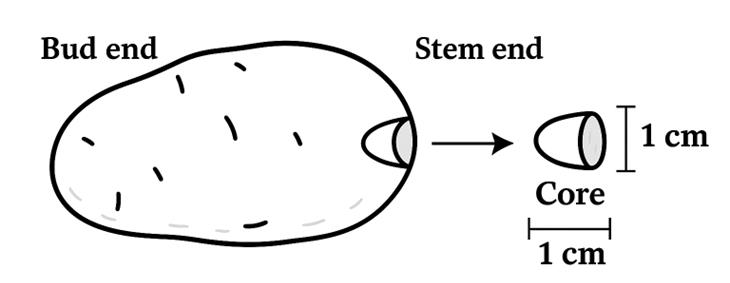
Description for Potato diagram
Cores must be taken at the stolon attachment site and must be conical or semi-spherical in shape, approximately 1 cm in diameter at the top and 1 cm deep. Each core should weigh approximately 0.5 to 1.0 g and include as much of the vascular ring radiating from the stolon attachment as possible.
Combining samples
Because follow-up measures on a BRR positive sample are taken on a crop or lot basis, samples from each crop or lot must be submitted to the lab in a closed, separate bag and individually labelled (so it can be linked to a lot or crop).
Each sample received by the laboratory is logged separately according to the certification number. However, per the official protocols followed by the laboratories, samples may be combined for testing purposes.
The maximum number of cores or stems that may be combined by the laboratory for testing purposes is 200 (bags containing more than 200 cores will be subdivided).
Tubers samples from different farm units may not be combined into 1 laboratory sample.
Since options are available for sample submissions to the lab, it is advisable to contact the lab manager to make appropriate arrangements.
Sample handling
Always use clean tools and containers to prevent cross-contamination. Keep samples cool and dry before shipping.
Sending samples
Send samples to a CFIA-approved lab list. Contact the lab in advance to confirm shipping instructions and timing.
Packaging and shipping
To ensure sample continuity from a specific crop or lot to the laboratory it is crucial to follow proper procedures for:
- packaging
- shipping
- identification
If sample integrity is in question, the sample will be discarded, and a new sample must be submitted.
When more than 1 tuber or core sample are shipped in the same container, a complete content list of samples submitted must be placed on the top of each shipping container or with the bill of lading. This list must be signed by the collector.
To ensure sample continuity, packages must be properly sealed so that they cannot be tampered with or opened during transit without the laboratory being aware of this upon arrival of the samples. If sample integrity is in question, the sample will be discarded, and a new sample must be submitted.
When outside temperatures are anticipated to drop below freezing (0°C), freezing of the samples must be prevented. Laboratory staff will reject any samples showing signs of freezing.
Tubers must be as dry as possible before packing. If tubers are sent in bags, tags bearing proper identification of the sample must be present both inside and attached to the outside of the bag (on top of the tubers). This is to identify the sample in case the outside tag is lost or damaged during transportation.
Cores dried and wrapped in paper towels, may be kept in cold storage (4°C) for a maximum of 14 days before processing by the laboratory; refrigeration at all times is important. Cores that become decayed during storage will be discarded by the laboratory and a new sample requested.
Cores must be as dry as possible before packing. If using plastic sealable bags, ventilation holes must be present in the surface. Some manufacturers of plastic bags for retail sale (for the purpose of refrigerating vegetables) are now offering finely perforated sealable plastic bags, which can be used very successfully for potato cores. Cores may also be wrapped in paper towels and shipped in plastic bags. Each bag must be properly identified. Bags must be closed and refrigerated as soon as possible and no more than 2 hours after coring sampling. The bags should be kept in cold storage (4°C) overnight and in such a way (that is, well spread out) that the complete sample is brought down to 4°C before shipping. The sample size indicated on the bags must be correct: the lab will only accept a 2% deviation from this number.
Bags of samples should be packed loosely in insulated cardboard boxes. Ice-packs should be included on top of the samples (as cold air moves downward), but should be sufficiently insulated from the samples so that freezing is avoided.
Ice-packs are effective only for a short period: 24 to 48 hours depending on insulation. Therefore, shipment of samples must be postponed if the package is likely to be held in transit over a holiday or weekend, except if refrigerated storage is available.
Sample identification
Each sample must be clearly labeled with:
- lot number
- variety
- farm unit
- date of sampling
- name and contact information of the grower or sampler
Appendix 4: Sampling rates during a BRR investigation
| Scenario | Sampling Requirement |
|---|---|
| Infected lot or crop | Will not be re-sampled or tested again |
| Sister lots or crops (same seed source as infected lot or crop) | Sample 2000 tubers per lot/crop |
| All other seed and non-seed lots or crops on the infected farm unit | Sample 1000 tubers per lot/crop |
| Lots or crops on other farm units that may have been exposed to common equipment used on the index farm | Sample 1000 tubers per lot/crop |
| Seed source farm, Pre-Elite lots and fields less than 0.025 Ha | 10% of the Pre-Elite lots, to a maximum of 500 tubers |
Appendix 5: Flow charts for BRR testing once it has been detected on a seed potato farm unit
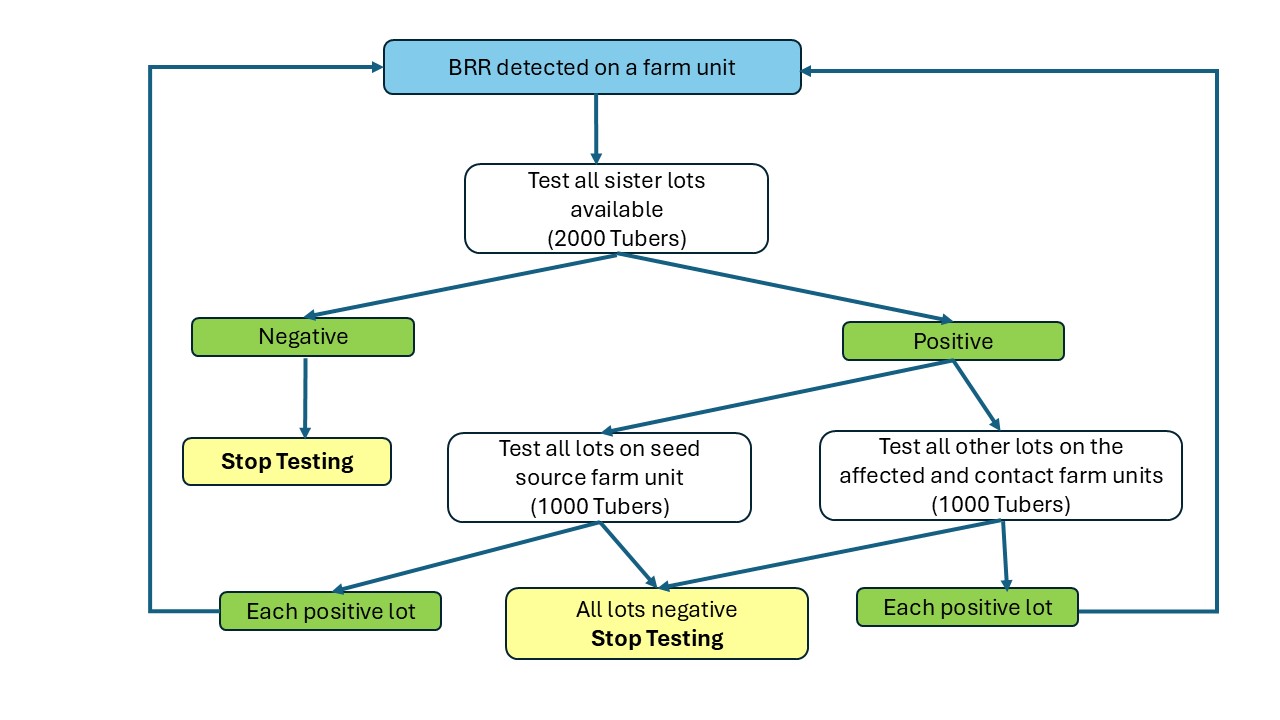
Description for Diagram 1 - Trace-out sister lots
When a BRR positive lot is detected on a farm unitand sister lots are available, all available sister lots should be tested using 2000 tubers per lot. If any sister lot is found to be positive, each of those positive sister lots must be tested. Following this, all other lots on the affected and contact farm units must again be tested using 1000 tubers per lot. If any of these lots are positive, each must be tested individually; if all are negative, testing can stop. Additionally, if any sister lots test positive, all lots on the seed source farm unit must be tested using 1000 tubers per lot.
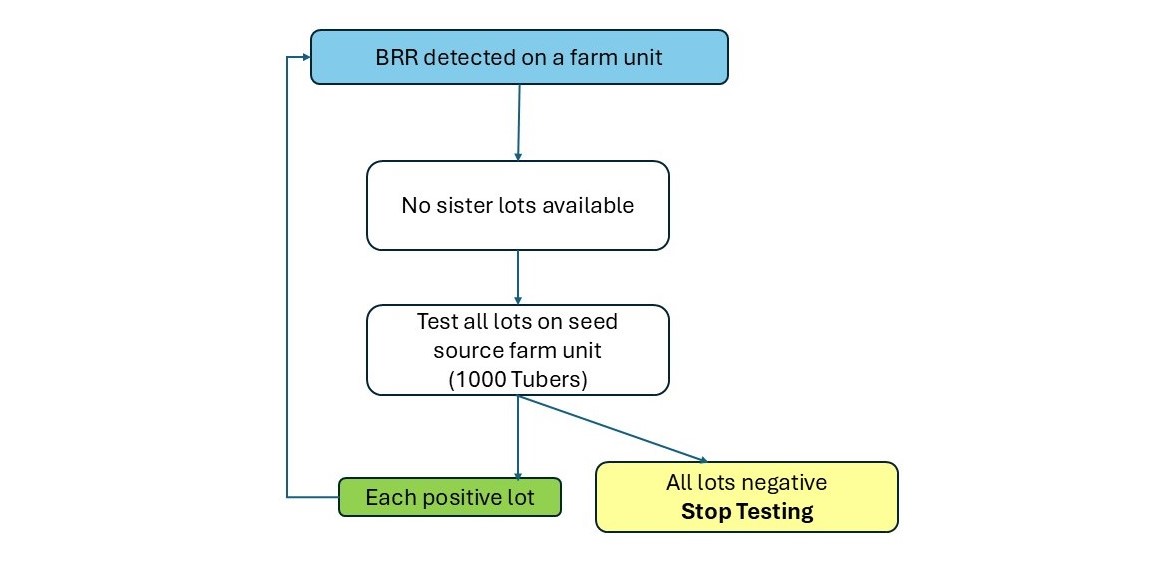
Description for Diagram 2 - Trace-out, sister lots are not available to test
When a BRR positive lot is detected on a farm unit and there are no sister lots available, testing must also be conducted on all lots from the seed source farm unit using 1000 tubers per lot. If any lot from either the affected/contact farm units or the seed source farm unit tests positive, the process must restart from the beginning with the newly identified positive lot. If all tested lots are negative, the testing process can stop.
Provincial government and potato growers' association representatives must be kept informed and may conduct further investigation on commercial units.
Appendix 6: Summary requirements
| Requirement | Established grower | Re-entering the CSPCP | New grower |
|---|---|---|---|
| Cleaning and disinfecting (C and D) Documentation |
|
|
|
| Seed source |
|
|
|
| Application process |
|
|
|
| Farm unit numbers |
|
|
|
| Field management |
|
|
|
| BRR testing |
|
|
|
| Seed shipped by the grower |
|
|
|
Appendix 7: Enhanced sampling rates
| Program phase | Period | Sampling requirements | Field size consideration | Lab |
|---|---|---|---|---|
|
Enhanced Sampling Program (Minimum of 3 years) |
Year 1 | Collected by the grower and under the CFIA supervision |
Every seed lot seed and non-seed to be tested. Minimum of 1,000 tubers per crop(s)/lot(s), regardless of class for fields greater than 1 hectare in area. For fields samller than 1 hectare, follow appendix 3 |
CFIA-approved laboratories |
| Year 2 and 3 | Collected by the grower |