
Latest revisions – November 2026
The Standard Inspection Process (SIP) has been updated to improve clarity and align with current inspection practices and terminology. Guidance related to the Digital Service Delivery Platform (DSDP), an internal system used by the Canadian Food Inspection Agency (CFIA) inspectors to record inspection information and document inspection decisions, has been removed from the SIP. Because this guidance is intended for internal use by CFIA inspectors, it is maintained separately, allowing the SIP to remain focused on inspection requirements and processes relevant to regulated parties.
What was revised
- Throughout the document: Terminology has been updated to reflect both regulatory and other applicable requirements. References to compliance and non-compliance have been revised where appropriate to recognize situations involving both regulatory compliance and adherence to established requirements.
- Section 2.0: Overview of the inspection: Guidance related to inspection activities has been clarified to improve consistency in how inspection activities are documented and managed.
- Section 3.3: Review information: References to correspondence and review processes have been updated to reflect current terminology.
- Section 6.2: Determine the scope of the follow-up inspection: Guidance has been clarified to confirm that follow-up inspection tasks relate to the original non-compliance(s) or non-adherence(s).
- Annex A: Digital Service Delivery Platform (DSDP) Guidance: This Annex has been removed from the SIP and is now maintained as a separate internal Agency document.
On this page
- Acronyms
- Definitions
- 1.0 Purpose
- 2.0 Overview of the inspection
- 3.0 Step 1 – Prepare for the inspection
- 4.0 Step 2 – Conduct the inspection
- 4.1 Engage with the regulated party (if necessary)
- 4.2 Conduct the initial walk-through (if necessary)
- 4.3 Confirm the scope
- 4.4 Perform inspection tasks
- 4.5 Assess inspection results
- 4.6 Categorize non-compliance or non-adherence
- 4.7 Determine if response action is required
- 4.8 Determine timeframe for regulated party to complete corrective actions
- 5.0 Step 3 – Communicate the inspection results
- 6.0 Step 4 – Conduct the follow-up inspection (if required)
Acronyms
- CFIA
- Canadian Food Inspection Agency
- CI
- Commodity Inspection
- CRM
- Client Relationship Management (a Microsoft Dynamics software)
- DSDP
- Digital Service Delivery Platform
- iAIM
- integrated Agency Inspection Model
- IMS
- Issues Management System
- LSTS
- Laboratory Sample Tracking System
- OG
- Operational Guidance
- PCI
- Preventive Control Inspection
- PCP
- Preventive Control Plan
- RDIMS
- Record Document and Information Management System
- SIP
- Standard Inspection Process
- SOP
- Standard Operating Procedure
- SME
- Subject Matter Expert
- SRM
- Specified Risk Material
- SRRP
- Standard Regulatory Response Process
Definitions
- Deviation
- A disparity between the regulated party's established preventive control plan (PCP) and the implementation of that PCP
- Digital Service Delivery Platform (DSDP)
- The Digital Service Delivery Platform is the CFIA central repository for recording inspection data, and documenting inspection decisions
- Hazard
- A biological, chemical or physical property that may cause an unacceptable health risk
- Non-adherence
- A failure to meet the applicable policy requirements
- Non-compliance
- A contravention of the applicable acts and/or regulations
- Objective evidence
- Clear and factual information, derived from verification activities and the common inspection techniques, which support the inspection result when requirements are not met. This information is provided on the Inspection Report that will be submitted to the regulated party once the inspection is completed
- Requirements
-
- Regulatory requirements are the provisions of acts and/or regulations that must be complied with by a regulated party
- Policy requirements are the terms and conditions of a program established by the CFIA, to meet program or trade obligations that must be adhered to by a regulated party in order to benefit from the privileges outlined in the program
- Permission eligibility requirements are the regulatory, policy or foreign country requirement a regulated party must meet to be eligible for the permission (for example a licence, permit, export or phytosanitary certificate)
- Risk
- The product of the severity of the consequences of a hazard/concern and the likelihood of occurrence of these consequences
1.0 Purpose
The standard inspection process (SIP) is the common approach for conducting inspections across the Canadian Food Inspection Agency's (CFIA's) 3 business lines (food, plant and animal health). The SIP follows the Integrated Agency Inspection Model (iAIM) in describing 4 standard inspection steps: preparing, conducting, communicating and conducting follow-up inspections (if required).
2.0 Overview of the inspection
Canadian Food Inspection Agency (CFIA) inspectors conduct inspections to determine permission eligibility; or to determine compliance to regulatory requirements; or adherence to policy requirements. There are 3 inspection task types: preventive control inspections (PCI), sample collection, and commodity inspections.
Preventive control inspection (PCI)
The PCI task type is used for the verification of a regulated party's preventive controls to determine if requirements are met. This could include a verification of a regulated party's systems-based approach that focuses on prevention as a way to achieve compliance or adherence.
Sample collection
The sample collection task type is used for planned and as required samples which are submitted to the lab for analysis. This may include samples required for national sampling plans, verification against regulatory standards or requirements, complaints and investigations, surveys and surveillance.
Commodity inspection
The commodity inspection task type is used for the verification of a regulated party's product or thing against regulatory standards or requirements. It enables the analysis of a product or thing done by inspection staff, as compared to the sample collection inspection task type which require inspection staff to submit samples to laboratories for analysis.
Business line specific inspection procedures and other guidance can be found on Merlin:
- Food business line (accessible only on the Government of Canada network)
- Animal health business line (accessible only on the Government of Canada network)
- Plant business line (accessible only on the Government of Canada network)
The 3 inspection task types can be used alone, or in combination, in a single inspection case. For example, if, during an inspection, additional verification is required that cannot be completed within the current task type (for example: PCI, commodity or sampling), add an appropriate task using one or more of the other task types. Alternatively, if an activity is undertaken outside of the scope or purpose of the inspection case (for example: work aligned with a separate plan or initiative), it should be recorded under a separate inspection. Refer to the relevant business line guidance for the applicable inspection task types.
Figure 1

Figure 1 – Text version
The rectangle at the top of the illustration states Standard Inspection Process.
The triangle in the middle represents the inspection task types that are included within an inspection case.
The inspection task types are listed from the left to right in a vertical orientation: commodity inspection, preventive control inspection, sample collection.
The rectangle below the triangle represents the verification activities conducted as part of the inspection task types.
The 4 verification activities are listed in 2 columns from left to right: In the left column – Document and Record Review and Observation, and in the right column – Interview and Measurement.
Inspectors use common inspection techniques for all 3 inspection task types to gather information and verify requirements are met. This information is used to support inspection decisions and any actions taken by the CFIA when requirements are not met.
Inspection information is entered and resides in the CFIA Digital Service Delivery Platform (DSDP). Procedures for the use of the DSDP to capture inspection data is found in Annex A: Recording inspection information in the DSDP (accessible only on the Government of Canada network – RDIMS 23722894); and on the DSDP Merlin page (accessible only on the Government of Canada network) in conjunction with the business line and commodity specific guidance.
The inspection process
There are 4 steps for completing preventive control, sample collection and commodity inspections, as depicted in figure 2 below.
Figure 2

Figure 2 – Text version
The inspection process is represented by 4 boxes.
Arrows lead from one box to the next in the following order:
Step 1: Prepare for the inspection leads to
Step 2: Conduct the inspection leads to
Step 3: Communicate the inspection results leads to
Step 4: Conduct the follow-up inspection
At any point in the inspection, advice and/or guidance may be needed. To request advice and guidance:
- search for relevant operational guidance;
- seek advice from the supervisor and the advisory continuum.
3.0 Step 1 – Prepare for the inspection
Objective:
- establish the purpose of the inspection
- familiarize with commodity, activities, hazards and controls, and the compliance or adherence history of the regulated party, where applicable
- determine the inspection tasks to be included as part of the identified scope
- identify areas for inspection emphasis
Preparing for an inspection consists of 5 parts, as represented in figure 3 below. However, note that the steps involved in the preparation of the inspection may not necessarily follow a linear process.
Figure 3

Figure 3 – Text version
Preparing for an inspection consists of 5 parts represented by 5 boxes.
Arrows lead from one box to the next in the following order:
3.1 Determining the scope of the inspection
3.2 Establishing the team
3.3 Reviewing information
3.4 Notifying the regulated party
3.5 Preparing the tool kit
3.1 Determine the scope of the inspection
The Digital Service Delivery Platform (DSDP) is the central repository for recording inspection data, and documenting inspection decisions. Each DSDP inspection case has a trigger and scope which includes one or more inspection tasks. Refer to Annex A: Recording inspection information in the DSDP (accessible only on the Government of Canada network – RDIMS 23722894), section A.4.1 – Determining the scope of the inspection.
Business line guidance indicates which DSDP triggers (reason for inspection) apply for specific programs. In the DSDP, there are 8 trigger options. The domestic, export and import permission triggers are used for inspections to determine permission eligibility. The other triggers are used for inspections to determine compliance or adherence to the requirements.
| Inspection trigger | Applied when |
|---|---|
| Preventive Control Inspection Plan | Conducting a preventive control inspection as per the national workplan |
| Sample Collection Plan | Collecting a sample to be submitted to a lab as per the national workplan |
| Commodity Inspection Plan | Conducting a commodity inspection as per the national workplan |
| Incident Response | Conducting an inspection in response to a suspect or realized risk |
| Domestic Permission | Conducting an inspection to support the issuance of a domestic permission |
| Export Permission | Conducting an inspection to support the issuance of an export certificate to a foreign country |
| Import Permission | Conducting an inspection to support the issuance of an import permission |
| ASD Verification | Conducting an inspection to verify that an alternate service provider meets CFIA requirements |
The scope of an inspection includes the following:
- one or more of the following inspection task types
- preventive control inspection
- sample collection
- commodity inspection
- one or more inspection tasks that are added to the inspection case in the DSDP
The inspection tasks may vary based on the inspection task type. A complete list of inspection tasks is available in the DSDP under Administration on the site map.
For information on accessing and creating an inspection case in the DSDP, refer to Annex A: Recording inspection information in the DSDP (accessible only on the Government of Canada network – RDIMS 23722894), section A.3 – DSDP inspection case information.
For additional DSDP case management information and specifically information on planned versus 'as required' inspections refer to DSDP inspection case management guidance (accessible only on the Government of Canada network – RDIMS 14671957)
3.2 Establish the team
Inspections may be conducted individually or in teams. The team may include subject matter experts (SMEs) to perform specific functions or provide additional support. The SMEs do not need to be present for the entire inspection.
When inspections are conducted by an inspector accompanied by SMEs, the SMEs serve in an advisory capacity. Regardless of whether an individual or a team is needed, determine:
- the skills, knowledge, experience and qualifications required to conduct the inspection by considering
- commodity, activities conducted by the regulated party, processes and/or treatment
- hazards, risk mitigation and control measures normally associated with the commodity/treatment/process
- inspection task type(s) assigned
- regulatory requirements and/or permission conditions
- the SMEs required, such as
- biologists
- veterinarians
- process specialists
- inspectors with audit skills
- persons providing language interpretation
- the team size and composition based on needs while considering
- the scope of the inspection
- size and complexity of the facility and its operations
- geographical location
- resources available
- roles, responsibilities and tasks for the team members and any SMEs
In some cases, inspections may be conducted in conjunction with inspectors from other government (for example, provincial or federal) departments and from other CFIA programs
Consult with the supervisor to verify legal authorities related to conducting inspections with other government departments, prior to agreeing to conduct a joint inspection.
3.3 Review information
Reviewing information is an important aspect of preparing for inspections. This includes information regarding the regulated party, the CFIA programs that the regulated party is associated with, their compliance or adherence history, applicable legislation and operational guidance and appropriate biosecurity measures to consider.
3.3.1 Regulated party/commodity information
If the regulated party have previously been inspected by CFIA, review:
- information regarding the regulated party such as hours of operation, commodities/processes/activities, permissions, hazards and risk mitigation, and controls related to the activities examined as part of the scope of the inspection
- any changes to the regulated party information since the last inspection (for example, email addresses, emergency contact information)
- any correspondence (for example, emails, formal review requests, letters) related to the regulated party since the last inspection
For information on reviewing the regulated party's profile in the DSDP, refer to Annex A: Recording inspection information in the DSDP (accessible only on the Government of Canada network – RDIMS 23722894), section A.4.3 – Review information.
3.3.2 History
Review the regulated party's history including:
- past CFIA inspection results, actions on permissions and control and enforcement actions
- any previous non-compliances or non-adherences and the associated timeframe for completion of corrective action
- granted requests for an extension to the timeframe for completion of a corrective action
- analytical reports (for example, past laboratory results including all results deemed other than satisfactory)
- complaints and recalls related to the commodity (for example, in the CFIA's Issues Management System – accessible only on the Government of Canada network)
For information on reviewing the regulated party's history in the DSDP, refer to Annex A: Recording inspection information in the DSDP (accessible only on the Government of Canada network – RDIMS 23722894), section A.4.3 – Review information.
3.3.3 Applicable requirements, documents
Review applicable regulatory or policy requirements associated with the scope of the inspection and any additional relevant operational guidance and references.
For information on requesting additional advice in the DSDP, refer to SOP Requesting Advice for an Inspection Case (accessible only on the Government of Canada network – RDIMS 9855738).
3.3.4 Applicable biosecurity measures
- If the inspection location has biosecurity measures that need to be respected:
- request biosecurity protocol(s) where commodity specific protocols exist
- review biosecurity measures applicable to the commodity and/or related activities to prepare accordingly. Ensure the flow of the inspection is conducted in a manner that does not introduce hazards and to reduce the potential of being a vector of pests, diseases and contaminants during the course of the inspection
- follow appropriate biosecurity measures for preparation, cleaning and sanitizing, for example, equipment and vehicles prior to arriving at the regulated party's premises
- review the Biosecurity for Inspection Activities OG (accessible only on the Government of Canada network – RDIMS 7500000), which provides horizontal guidance for the inspector to make decisions with respect to biosecurity measures
- review the Operation Procedure Sanitation and/or decontamination of mobile devices for routine operations
For information on requesting additional advice in the DSDP, refer to SOP Requesting advice for an inspection case (accessible only on the Government of Canada network – RDIMS 9855738).
3.4 Notify the regulated party to schedule an inspection (when required)
CFIA inspectors have the authority to enter a regulated party's premises to perform inspections, announced or unannounced. The purpose of the inspection usually dictates if an announced or unannounced inspection is required. The inspectors are to use their judgement and consult with their supervisor to determine whether notification is required.
Inspectors may notify the regulated party to schedule an inspection to ensure that:
- appropriate staff are available on the inspection date
- the facility is in operation during a scheduled inspection
- specific processes and products are available to be inspected on the date of inspection
At the same time, inspectors should ensure that the regulated party informs the CFIA in advance of any relevant changes that may affect the inspection. Footnote 1
Notification can be provided verbally or in writing via an e-mail. The notification letter template (accessible only on the Government of Canada network – RDIMS 11289579) can be used to assist in notifying the regulated party of a future inspection.
For information on completing the DSDP, refer to Annex A: Recording inspection information in the DSDP (accessible only on the Government of Canada network – RDIMS 23722894), section A.4.4 – Notify the regulated party.
3.5 Prepare the toolkit
- Review the list of equipment described in the Inspector toolkit (accessible only on the Government of Canada network – RDIMS 11289973).
- Determine if any additional equipment is required based on the commodity and activities covered in the scope of the inspection.
For information on completing the DSDP, refer to Annex A: Recording inspection information in the DSDP (accessible only on the Government of Canada network – RDIMS 23722894), sections:
- A.3.3 – Recording time within the inspection case, and section
- A.3.4 – Notifications using DSDP.
4.0 Step 2 – Conduct the inspection
Objective:
- to verify applicable requirements are met
Conducting an inspection consists of the parts as represented in figure 4 below.
Figure 4

Figure 4 – Text version
Conducting the inspection consists of 8 steps.
- 4.1 Engage with the regulated party (if necessary),
- 4.2 Conduct the initial walkthrough (if necessary),
- 4.3 Confirm the scope,
- 4.4 Perform inspection tasks,
- 4.5 Assess inspection results,
-
If non-compliance or non-adherence identified,
4.6 Categorize non-compliance or non-adherence,
- 4.7 Determine if response action is required,
-
4.8 Determine timeframe for corrective actions,
Proceed to 5.0 Step 3 Communicate
Important note
At any time during an inspection, where it is determined that there is a potential for human, animal or plant health, or the environment or economy/trade to be impacted, inspectors may need to conduct an incident response and or take control action.
Prior to taking such action:
- consult with a supervisor (if necessary) to determine if immediate action is required
- communicate with the regulated party contact to assess the need for further action and ensure immediate control of the affected commodity
Use the standard regulatory response process (SRRP) and business line specific guidance, which outline the control action available.
For information on capturing notes relating to control actions in the DSDP, refer to Annex A: Recording inspection information in the DSDP (accessible only on the Government of Canada network – RDIMS 23722894), section A.5.6 – Capture response actions.
4.1 Engage with the regulated party (if necessary)
A preliminary step to conducting an inspection is to determine whether it is necessary to engage with the regulated party prior to initiating inspection activities. The level of engagement with the regulated party may be a simple greeting before the start of the inspection or it may be a more formal opening meeting. For some inspections, (for example, surveying public lands for the presence of quarantine pests), engagement is not required. For inspections requiring direct engagement with regulated party, confirm the official language of choice of the regulated party.
Regardless of the level of engagement, provide the privacy notice statement by hard copy, or verbally prior to the inspection (Privacy Notice Statement, accessible only on the Government of Canada network – RDIMS 11606579).
When an opening meeting is required, the inspector will:
- communicate the legal authority, CFIA responsibilities, inspection scope, inspection process and resources required to the regulated party, including those responsible for the activities being examined
- provide an opportunity for clarification and exchange of information
The opening meeting may be formal or a basic discussion of inspection details.
During the opening meeting the inspector will:
- introduce all participants (CFIA, regulated party, SMEs and any other government personnel present), to clarify roles and responsibilities
- display CFIA designation card and/or badge
- communicate the inspection scope, estimated duration, process to be used
- indicate that the regulated party will be advised of any changes to the scope during the course of the inspection
During the opening meeting the inspector may also (where applicable):
- identify the status of non-compliances or non-adherence from previous inspections, obtain the status of corrective measures, and confirm if any extensions to permanent corrective action implementation deadlines have been requested and granted
- request that key staff or resources required are identified and available to assist with the inspection
- confirm whether there are any changes to the regulated party's profile such as to the establishment, equipment, commodities or activities and note any revisions in the DSDP
- confirm the regulated party's biosecurity and health and safety standards (including applicable provincial legislation)
- advise that an end-of-day discussion may be conducted to provide information of the day's inspection results, including any non-compliance or non-adherence that were observed; that is, when inspections take more than 1 day to complete
- determine an approximate date, time and location for the closing meeting
Refer to Opening/closing meeting checklists (accessible only on the Government of Canada network – RDIMS 11289897) for an opening meeting checklist that can be printed and taken out on inspection.
For information on completing the fields relating to the opening meeting in the DSDP, refer to Annex A: Recording inspection information in the DSDP (accessible only on the Government of Canada network – RDIMS 23722894), section A.5.1 – Conduct the opening meeting.
4.2 Conduct the initial walk-through (if necessary)
An initial walk-through is not mandatory for all inspections. The inspector has the discretion to determine if an initial walk-through is necessary.
If an initial walk-through (interior/exterior) is conducted, then:
- observe any new commodities, operations, equipment, establishment extensions and practices;
- identify aspects within the preliminary scope that should be either emphasized or targeted for more intensive inspection and areas that should be added to the scope of the inspection (for example, add preventive control sub-element tasks; commodity inspection tasks; or sample collection inspection tasks);
- ensure the permissions are aligned with the activities taking place;
- ensure that the flow of the inspection does not introduce hazards and respects biosecurity principles applicable to the commodity and/or related activities; and
- verify, where applicable, that interim measures are still effective for outstanding non-compliances where the timeframe for completion of corrective actions has not yet passed.
For information on completing the fields relating to the initial walk-through in the DSDP, refer to Annex A: Recording inspection information in the DSDP (accessible only on the Government of Canada network – RDIMS 23722894), section A.5.2 – Conduct the initial walk-through.
4.3 Confirm the scope
When confirming the scope:
- determine if the preliminary scope remains the same or if an amendment is required
- identify aspects within the preliminary scope that should be either emphasized or targeted for more intensive inspection and areas that should be added to the scope of the inspection (for example, add preventive control, sample collection, or commodity inspection tasks)
- record the justification for the change to the scope where applicable; and
- communicate any changes to the scope to the regulated party as soon as possible
The inspector should respect the preliminary scope where possible.
Potential reasons to amend (change, expand or reduce) the inspection scope include:
- identified potential food safety concern or potential plant or animal health issue
- changes in activity (for example, regulated party has begun or stopped exporting)
- recalls or complaints
- non-compliance with contributing factors linked to another sub-element outside the initial scope
- outstanding non-compliances within sub-elements not in the current inspection scope where interim measures are not effective
If outstanding non-compliances have been discovered in the initial walk-through, verify that interim measures are still effective. If the interim measures are no longer effective, and the applicable tasks are not already within the initial inspection scope, then expand the scope and perform the activities related to the outstanding non-compliances.
For information on confirming or adjusting the inspection scope in the DSDP, refer to Annex A: Recording inspection information in the DSDP (accessible only on the Government of Canada network – RDIMS 23722894), section A.5.3 – Confirm the scope.
4.4 Perform inspection tasks
Performing inspection tasks allows an inspector to verify that a regulated party is meeting requirements. DSDP inspection cases will normally include one or more inspection tasks of the three inspection task types (preventive control inspection, commodity inspection or sample collection).
For information on the fields associated to all task types in the DSDP, refer to Annex A: Recording inspection information in the DSDP (accessible only on the Government of Canada network – RDIMS 23722894), section A.5.4.1 - Inspection verification activities for preventive control inspections (PCI), sample collection, and commodity inspections.
4.4.1 Preventive control inspection
The preventive control inspection task type is used to verify that a regulated party's preventive controls meet requirements. This could include a regulated party's systems-based approach that focuses on prevention as a way for a regulated party to achieve compliance or adherence.
This inspection type evaluates the regulated party's preventive controls as applicable to the regulated party's operation including regulatory requirements and/or policy requirements for animal and plant health, food safety and labelling, product quality, and composition.
Preventive control inspections may be required to evaluate systems-based programs prior to approval, or to maintain the permission or status in specific programs.
The inspector uses the outcomes, verification activities and performance criteria related to each preventive control inspection task to verify compliance or adherence of a regulated party's preventive controls against the applicable requirements. Each preventive control inspection sub-element lists the outcome, verification activities and performance criteria that will be required to perform the inspection.
4.4.2 Sample collection
The sample collection task type is used for planned and as required samples which are submitted to the lab for analysis.
Samples may be required for national sampling plans, verification against regulatory standards or requirements, complaints and investigations, surveys or surveillance. Examples include sample collections for product identity, assessment for soil or pests, evaluation for toxins or disease.
Business line guidance provides procedures for the notification and submission of samples to the laboratories. The Laboratory Sample Tracking System (LSTS – accessible only on the Government of Canada network) is the main tool used by the CFIA to track and compile the information pertaining to laboratory samples. Business line operational guidance describes the manner in which sampling information is collected, analyzed and reported.
For information on capturing notes relating to taking samples in the DSDP, refer to Annex A: Recording inspection information in the DSDP (accessible only on the Government of Canada network – RDIMS 23722894), section A.5.4.1 - Inspection verification activities for preventive control inspections (PCI), sample collection, and commodity inspections.
4.4.3 Commodity inspection
The commodity inspection task type is used for the verification of a regulated party's product or thing against requirements. It enables the analysis of a product or thing done by inspection staff, as compared to the sample collection task type which require inspection staff to submit samples to laboratories for analysis.
Commodity inspections can consist of a wide range of inspection activities that are conducted by the inspector on the commodity including, for example, label verification, crop inspection, specified risk material (SRM) inspection.
The inspector evaluates commodities based on applicable requirements. Business line operational guidance describes the way commodity information is evaluated and reported.
For information on capturing notes relating to commodity inspections in the DSDP, refer to Annex A: Recording inspection information in the DSDP (accessible only on the Government of Canada network – RDIMS 23722894), section A.5.4.1 - Inspection verification activities for preventive control inspections (PCI), sample collection, and commodity inspections.
4.4.4 Inspection verification activities for preventive control inspections, sample collection and commodity inspections
Inspectors use a combination of inspection verification activities to assess if requirements are met for all 3 inspection task types (preventive control inspection, sample collection, and commodity inspection), including – where applicable:
- document and record review
- observation
- interview
- measurement
4.4.4.1 Document and record review
The purpose of examining documentation and record is to:
- target areas, product or processes to be inspected (for example, areas of higher risk)
- verify if the procedures are complete, implemented accordingly and are effective
- verify that requirements pertaining to documents and records are being met
Examples include processing records, complaint records, training records, sanitation records, sample and testing results, certificates, receiving records, Preventive Control Plan (PCP), permission documents.
If applicable, inspectors should review documentation and records using the following guidelines:
- select a representative cross-section of the records to identify and observe any deviations and corrective actions taken
- note any inconsistencies (for example, gaps, anomalies)
For information on capturing notes relating to document and record reviews in the DSDP, refer to Annex A: Recording inspection information in the DSDP (accessible only on the Government of Canada network – RDIMS 23722894), section A.5.4.1 - Inspection verification activities for preventive control inspections (PCI), sample collection, and commodity inspections.
4.4.4.2 Observation
Observation is not limited to visual assessment alone; it may also include sensory factors such as using hearing, touch and smell.
The purpose of observations is to gather information to evaluate whether:
- the commodity meets requirements (for example, no contamination observed, no unacceptable odours)
- the program is implemented as described and is effective
- the conditions of the premises and locality (for example, weather, environmental factors) impacts food safety, animal or plant health
- the conditions and functioning of the equipment impacts food safety, animal or plant health
- the employees are conducting their work activities, as per the established procedures
For information on capturing notes relating to observations in the DSDP, refer to Annex A: Recording inspection information in the DSDP (accessible only on the Government of Canada network – RDIMS 23722894), section A.5.4.1 - Inspection verification activities for preventive control inspections (PCI), sample collection, and commodity inspections.
4.4.4.3 Interview
The purpose of the interview is to confirm that the employees:
- understand the procedures that they are to follow to produce safe and compliant commodities, and have put these procedures into practice
- know when and how to take corrective action if an issue or deviation arises; including taking immediately control of affected or potentially affected product(s)
- keep accurate and complete records
- have appropriate training to conduct their assigned tasks
For information on capturing notes relating to interviews in the DSDP, refer to Annex A: Recording inspection information in the DSDP (accessible only on the Government of Canada network – RDIMS 23722894), section A.5.4.1 - Inspection verification activities for preventive control inspections (PCI), sample collection, and commodity inspections.
4.4.4.4 Measurement
Measurements taken during the course of an inspection, support inspection decisions and allow the completion of assigned inspection tasks activities. Measurement includes activities such as taking temperature, humidity, moisture content or presence of soil. This section also allows for specific descriptors to be documented such as tattoo identification, lot identification and breed, for example.
For information on capturing notes relating to measurements in the DSDP, refer to Annex A: Recording inspection information in the DSDP (accessible only on the Government of Canada network – RDIMS 23722894), section A.5.4.1 - Inspection verification activities for preventive control inspections (PCI), sample collection, and commodity inspections.
4.5 Assess inspection results
During this step, inspectors interpret and analyze the information collected during the inspection to determine if requirements are met.
For inspections to determine permission eligibility (for example: DSDP domestic, export or import permission triggers):
- if permission eligibility requirements are met, recommend the permission be issued
- if permission eligibility requirements are not met, recommend the permission not be issued
Proceed to section 5.0 Step 3 – Communicate the inspection results
For additional information, see business line guidance for the given permission.
For inspections to determine compliance to regulatory requirements or adherence to policy requirements (non DSDP permission triggers):
- if requirements are met, proceed to section 5.0 Step 3 – Communicate the inspection results,
- if requirements are found not to have been met this results in a non-compliance or non-adherence; proceed to section 4.6 Categorize the non-compliance or non-adherence.
For information on capturing the non-compliance or non-adherence and objective evidence in the DSDP, refer to Annex A: Recording inspection information in the DSDP (accessible only on the Government of Canada network – RDIMS 23722894), section A.5.5 – Assess inspection results.
4.6 Categorize non-compliance or non-adherence
Note: See business line guidance for any additional guidance.
The categorization of non-compliance or non-adherence assesses the potential consequences and the likelihood of occurrence. The purpose of categorizing is to inform:
- timeframes for regulated party to take effective corrective actions
- timeframes for CFIA follow-up inspections
- adjustment of level of CFIA oversight
- program design/re-redesign
The process of categorization is organized into 4 steps (sections 4.6.1 to 4.6.4) which seek to answer questions raised intuitively when assessing the level of impact that may result from a non-compliance or non-adherence.
The category is based on the impacts of the individual non-compliance or non-adherence, not on the history or intent of the regulated party. History and intent will be taken into account as part of the response action process, if required. Refer to the SRRP.
The Categorization of Non-Compliance Process document (accessible only on the Government of Canada network – RDIMS 11292219) outlines the process for categorization.
4.6.1 Identify the type and sub-type
Identify the type and sub-type of non-compliance based on the information collected during the inspection.
Select all applicable types and sub-types that reflect the impact caused by the non-compliance. See below for a list of non-compliance types.
| Type | Sub-type | Characteristics |
|---|---|---|
| Health (human, animal, plant) |
Biological | Any pathogen, pest or vector of a pathogen or pest that poses a danger to human, animal or plant health or the environment (for example, bacteria, viruses, parasites, prions, insects) |
| Health (human, animal, plant) |
Chemical | A chemical substance that is not normally found in a commodity or that exceeds allowable levels in a commodity and poses a danger to human, animal or plant health or the environment (for example, veterinary drugs, contaminants, pesticides, toxins) |
| Health (human, animal, plant) |
Physical | Any foreign material that is not normally found in or on a commodity or that poses a danger to human, animal or plant health or the environment |
| Health (human, animal, plant) |
Allergen | The presence of undeclared or improperly declared allergens |
| Health (human, animal, plant) |
Nutritional | Incorrect nutritional composition in a commodity |
| Health (human, animal, plant) |
Animal Welfare | Conditions of the environment or situations/practices that may cause avoidable injury, avoidable suffering or death of animals (for example, overcrowding, restricted space, improper ventilation) |
| Environmental | Other | Any issues that may create an environmental concern (for example, contamination from plants with novel traits, invasive alien species) |
| Economic | Consumer protection, Fraud, Misrepresentation, Risk to industry sector, Other | Issues resulting in unfair economic gain for the regulated party; economic loss to consumers, competitors or industry sector because use of unfair or deceptive practices |
| Trade | Risk to export eligibility, Other | Issues affecting or having the potential to affect domestic or international trade or relations |
| Other | Other | No effect on humans, plants, animals, the environment, the economy or trade |
4.6.2 Determine the severity of consequence(s)
Determine the severity of the consequence of the non-compliance or non-adherence if the consequences were to occur.
The 3 levels of severity of consequences are defined as:
Low: exposure to the hazard/concern is not likely to cause any adverse consequences for humans, plants, animals, the environment, the economy or trade
Medium: exposure to the hazard/concern could result in temporary or non-critical consequences to humans, plants, animals or the environment or have a moderate effect on the economy or trade
High: exposure to the hazard/concern could cause permanent disability or death for humans, plants, animals, or serious effects on the environment, the economy or trade
If there is insufficient information to determine severity of consequences, use the Guide for determining the severity of consequences of non-compliance (accessible only on the Government of Canada network – RDIMS 11289853) to help determine the level of severity (low, medium or high). If the guide does not provide enough information to help in the determination of the severity, then the severity is "high" until demonstrated otherwise Footnote 2.
The severity of consequences is represented on the horizontal-axis of the Categorization Matrix (Figure 5), found in section 4.6.4.
4.6.3 Determine the likelihood of occurrence
Determine the likelihood of occurrence of the consequences of the non-compliance, based on the controls of the regulated party over the hazard or concern.
The 3 levels of likelihood of occurrence are defined as:
Very likely: There are little or no control(s) in place, the controls are not effective or there is high potential for exposure to the hazard or concern
Likely: There are some control and/or mitigation measures in place and there may be gaps, inconsistency, or some potential exposure to the hazard or concern
Unlikely: The controls are in place and effective, mitigation addresses the issue and there is minimal potential exposure to the hazard or concern
To determine the level of likelihood, consider the inspection results related to control measures.
Review control measures that reduce, mitigate or increase the likelihood of occurrence. Consider the regulated party's controls from initial inputs to end use.
Below are some recommended actions to consider when determining the likelihood of occurrence (very likely, likely or unlikely):
- select very likely in situations where the likelihood of occurrence cannot be determined due to high uncertainty, until additional information can be obtained
- identify whether there are any controls
- determine effectiveness of controls (for example, are they working and doing their job)?
- review the controls in place for the preventive control inspection sub-element(s) where the non-compliance or non-adherence was found
- review the controls in place for the preventive control inspection sub-element(s) other than where the non-compliance or non-adherence was found
- review control measures at any other point in the process that reduces, mitigates or increases the likelihood of occurrence
- determine if the non-compliance or non-adherence affect other control measures (for example, other controls will be rendered ineffective)
- assess whether other controls or factors exist that may eliminate or minimize the likelihood of occurrence of the hazard (for example, the commodity is subject to additional processing before packaging, the animal is vaccinated prior to movement)
- determine if conditions exist specific to the commodity or host-specific conditions that may decrease or increase the likelihood of exposure to the hazard (for example, mitigating factor or aggravating factor like a commodity that supports the growth of the biological hazard)
- assess the effectiveness of controls in relation to the initial level of contamination
Depending on the inspection type, different information is available to help determine likelihood of occurrence:
- preventive controls and performance criteria can be considered for a preventive control inspection as well as for any commodity or sample collection inspection task types created under a preventive control inspection
- preventive controls and performance criteria are not considered if a commodity or sample collection inspection task type is done outside of a preventive control inspection
If the consequence of the non-compliance or non-adherence has already occurred, the probability of occurrence is very likely in all cases and for all types of inspection tasks.
The likelihood of occurrence is represented by the vertical-axis in the Categorization Matrix (Figure 5), found in section 4.6.4.
4.6.4 Categorize the non-compliance or non-adherence
Figure 5: Categorization Matrix
Categorize a non-compliance or non-adherence based on its impacts using the Categorization Matrix in Figure 5 below:

Figure 5: Categorization Matrix – Text version
The horizontal axis represents the severity of consequences and is divided into low, medium and high. The vertical axis represents the likelihood of occurrence and is divided into unlikely, likely and very likely.
A low severity of consequence results in minimal categorization for any likelihood of occurrence and the boxes are coloured yellow.
A medium severity of consequence results in minimal categorization for unlikely likelihood of occurrence and moderate categorization for likely and very likely likelihood of occurrence and the boxes are coloured orange.
A high severity of consequence results in minimal categorization for unlikely likelihood of occurrence represented by a yellow box, moderate categorization for likely likelihood of occurrence represented by an orange box, and severe categorization for very likely likelihood of occurrence represented by a red box.
The objective evidence should clearly support the categorization decision.
If a non-compliance or non-adherence has more than oneFootnote 3 type or hazard or concern identified, repeat steps in sections 4.6.1 to 4.6.4 until the most severe category is identified and record the most severe category in the DSDP.
For information on capturing the categorization in the DSDP, refer to Annex A: Recording inspection information in the DSDP (accessible only on the Government of Canada network – RDIMS 23722894), section A.5.5 – Assess inspection results.
4.7 Determine if response action is required
In addition to determining the timeframe for corrective action, assess if control or enforcement actions, actions on a permission, or other policy-based response actions are warranted.
Guidance on these assessments can be found in the Standard regulatory response process, the Enforcement and investigation file referral standard (EIFRS) (accessible only on the Government of Canada network – RDIMS 18266484), and in business line policy or guidance.
For information on capturing the response actions in the DSDP, refer to Annex A: Recording inspection information in the DSDP (accessible only on the Government of Canada network – RDIMS 23722894), section A.5.6 - Capture response actions.
If immediate response actions are not warranted or if in addition to a response action being taken a timeframe for corrective action can be provided to the regulated party, proceed to section 4.8.
4.8 Determine timeframe for corrective actions
The regulated party is required to meet the requirements at all times; however, it is recognized that they may need some time to take permanent corrective action when non-compliance or non-adherence occurs. In the meantime, effective interim measures must be taken to address any non-compliance or non-adherence.
The timeframe to complete corrective actions must reflect the severity of the impact of the non-compliance or non-adherence and take into consideration, when possible, the time required for the regulated party to address the root cause and permanently correct the non-compliance or non-adherence. Timeframes are assigned by the inspector based on Table 3. See business line guidance for determining the timeframe for corrective action for non-adherence.
Non-compliance that requires immediate action should be identified to the regulated party and must be addressed with an interim measure or permanent corrective action. If an interim measure is put in place, the inspector may allow up to 10 days for the regulated party to complete the permanent corrective action.
Note: for all non-compliances or non-adherences, the timeframe to complete corrective actions is calculated starting the day after the regulated party was notified by the inspector of the non-compliance.
| Category | Timeframe for regulated party to complete corrective action (in calendar days) |
|---|---|
| Severe | Up to 10 days |
| Moderate | Up to 60 days |
| Minimal | Up to 180 days |
Where a corrective action was implemented prior to the closing meeting, the inspection results record and a corrective action due date that aligns with the category must still be recorded in DSDP. A follow-up inspection will need to be conducted based on the timeframe provided to ensure that effective corrective action has been implemented.
For information on capturing the timeframe(s) to complete corrective actions and to whom the inspection result was reported to in the DSDP, refer to Annex A: Recording inspection information in the DSDP (accessible only on the Government of Canada network – RDIMS 23722894), section A.5.5.2 – Creating an inspection result record.
4.8.1 Schedule CFIA follow-up inspections
Follow-up inspections are conducted to verify that effective corrective actions have been taken.
A due date for the follow-up inspection is auto-populated in DSDP, one day past the date for completion of corrective action.
The planned inspection date should be the same as the due date or as soon as possible after, however, there may be situations where that is not practical. For example, where seasonal operators are not in operation at the due date of the follow-up inspection follow-up inspections for these situations can be conducted at the start of the next season's operations.
For information on creating a follow-up inspection and adding a planned inspection date in the DSDP, refer to Annex A: Recording inspection information in the DSDP (accessible only on the Government of Canada network – RDIMS 23722894), section A.5.7 – Creating follow-up inspection cases.
5.0 Step 3 – Communicate the inspection results
Objective:
- communicate the results of the inspection and any non-compliances or non-adherences observed
- provide an opportunity for discussion at the end of the inspection
- communicate the timeframes for the regulated party to complete permanent corrective actions
- evaluate requests for extension to timeframes for corrective action completion
- provide the written inspection report (when required)
Note: for inspections that span more than 1 day, a brief end-of-day discussion can be held to summarize the events and findings of the day and to plan for the remainder of the inspection.
Figure 6
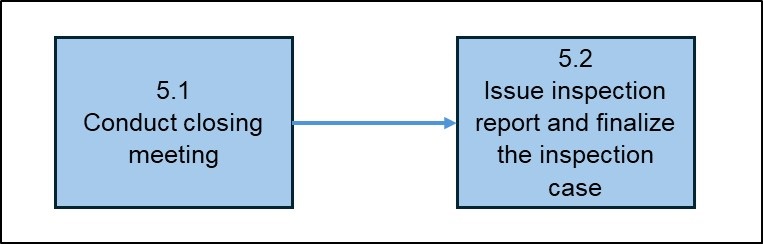
Figure 6 – Text version
There are 2 steps to communicating the inspection results represented by 2 boxes.
Arrows lead from one box to the next in the following order:
- 5.1 Conducting the closing meeting,
- 5.2 Issuing inspection report and finalizing the inspection case.
5.1 Conduct closing meeting
A closing meeting is held once the inspection and all inspection tasks are completed. The closing meeting may be formal or an informal discussion of inspection results. The purpose is to provide verbal feedback to the regulated party regarding the results of the inspection, and any non-compliance or non-adherences observed. In the situation where the inspector requires additional clarification (for example, with the supervisor at the CFIA office to review/validate inspection information) the closing meeting may be conducted up to a few days after the on-site inspection.
During the closing meeting, the inspector may, where applicable:
- discuss the overall results of the inspection
- discuss and clarify any actions or control measures taken by the regulated party or the inspector during the inspection
- provide a verbal presentation of all non-compliances or non-adherences identified
- communicate to the regulated party if further analysis and consultation are required to determine compliance or adherence
- provide the timeframes for completing corrective actions related to each non-compliance or non-adherence and explain that the follow-up inspection will assess if effective corrective action has been taken and compliance or adherence has been re-established
- indicate that the inspection report will be provided as soon as possible (ideally within 5 working days from completion of the inspection verification activities)
- respond to questions, concerns or requests for clarification expressed by the regulated party
- discuss any required next steps and expectations
Inspectors must notify their supervisor immediately if there is disagreement from the regulated party over the timeframe provided for corrective action, any action taken by inspectors or the potential impact on the regulated party's operations or the commodity.
Refer to Opening/closing meeting checklists (accessible only on the Government of Canada network – RDIMS 11289897) for a Closing meeting checklist that can be printed and taken out on inspection.
For information on capturing notes relating to the closing meeting in the DSDP, refer to Annex A: Recording inspection information in the DSDP (accessible only on the Government of Canada network – RDIMS 23722894), section A.6. – Communicate the inspection results.
5.2 Issue inspection report and finalize the inspection case
The inspection documentation presented to the regulated party is the final inspection report. In certain situations, an inspection report may not be issued. Refer to program specific guidance for more information.
The purpose of the inspection report is to communicate to the regulated party:
- that an inspection was conducted
- which inspection tasks were completed
- the inspection results (permission eligibility or all non-compliances or non-adherences) found
- and when applicable, timeframe for completion of corrective action.
The inspector returns to the office, completes the inspection report and submits it to their supervisor for review and approval, if applicable.
Once the report is approved by the supervisor, if applicable, the inspector signs it and sends it to the regulated party via the MyCFIA portal, as well as other means if requested (for example, email or fax). If the regulated party requests a meeting to discuss the inspection report, the inspector uses their judgement to decide if a phone call, or subsequent meeting is needed.
Review the CFIA fee schedule for fees that are linked to inspection tasks. Apply the fees according to the Operational procedure (OP/PO-175): Collection and invoicing of user fees for cost recoverable inspection activities and service requests (accessible only on the Government of Canada network – RDIMS 6159161).
Once the inspection report has been submitted to the regulated party and all required fields in the inspection case have been completed, the inspection case must be deactivated (closed) to prevent any further editing.
Reminder: only details of the non-compliance or non-adherence and objective evidence is to appear on the inspection report. Recommendations and opinions are not appropriate.
For information on completing the remaining fields, generating an inspection report and saving this report in the DSDP, refer to Annex A: Recording inspection information in the DSDP (accessible only on the Government of Canada network – RDIMS 23722894), sections:
- A.3.3 – Recording time with the inspection case
- A.6 – Communicate the inspection results
5.3 Review request for extension to timeframe for corrective action completion
In some situations, a regulated party may require more time to implement permanent corrective action than the timeframe originally allocated. For example, a regulated party may require major capital initiatives or additional time to take effective corrective actions such as restoring building structures or purchasing new equipment. Where there is no impact on food/plant/animal health and the environment, timeframes to complete corrective action may be extended.
A written request can be made by the regulated party for an extension to the timeframe for completing corrective actions.
The following describes the information required and circumstances to be considered for the review and decision on whether or not an extension request should be granted.
5.3.1 Information required for assessing the request
Written requests for extensions must be submitted prior to the original established completion date.
The request includes:
- the rationale for requesting the change
- the non-compliances or non-adherences associated with the extension request, and a description of the interim measures
- a proposed new timeframe for the corrective action to be completed
- any additional documentation on the extenuating circumstances that supports the need for an extension
5.3.2 Granting and denying requests for an extension
An extension can be granted when:
- a written, valid request for an extension is submitted before the original established completion date which includes the required information as described in section 5.3.1;
- human, animal, or plant health or the environment is not compromised, due to the extension; and
- interim measures are effective
For information on capturing an extension in the DSDP, refer to Annex A: Recording inspection information in the DSDP (accessible only on the Government of Canada network – RDIMS 23722894), section A.6.4. – Request for extension to timeframe for corrective action.
Extension requests may be denied when criteria set out above and in section 5.3.1 are not met.
5.4 Formal review of inspection results
If the regulated party disagrees with the inspection results, they should contact the lead inspector named on the inspection report as a first step. If the concern continues to be unresolved, the regulated party can request a formal review by submitting the reason of the request in writing to the Inspection supervisor prior to the date for completion of corrective action indicated on the inspection report. It is important to note the regulated party must have interim measures in place to control any immediate risk, whether or not the regulated party requests a formal review of the inspection results. The submission for the request for review must include the final inspection report and must clearly identify the section(s) of the report to be reviewed.
When the Inspection Supervisor receives the formal request for review from the regulated party, they should:
- confirm receipt of the request
- review the request with the lead inspector and inspection team
- support the lead inspector in seeking advice from local operations management and advisory staff as necessary
Following review with the inspection supervisor and other subject matter experts (inspection advisors, inspection team, inspection manager, etc.), the lead inspector decides whether to confirm or modify the inspection results.
If the lead inspector decides to modify the inspection results, they should:
- amend the inspection case by referring to Annex A: Recording inspection information in the DSDP (accessible only on the Government of Canada network – RDIMS 23722894), section A.6.5 – Amending a closed inspection.
- add a note to the original non-compliance record to explain the modification (for example, that the inspection showed no non-compliance)
- if the category of non-compliance and date for completion of corrective action has been adjusted, update the non-compliance record accordingly, adjust the due date in the follow-up case and re-issue the inspection report
- if the corresponding follow-up case is no longer required, cancel it with the reason 'Cancelled – Inspection Decision Reversed' by referring to the DSDP SOP INS Update, Close and Cancel an Inspection Case (accessible only on the Government of Canada network – RDIMS 9852255)
The lead inspector documents the result of the review and the rationale for their decision using the Formal review record of decision template (accessible only on the Government of Canada network – RDIMS 20412890). The lead inspector uses the information from this document to complete the Formal review decision notification letter template (accessible only on the Government of Canada network – RDIMS 18868227).
The lead inspector saves the Record of Decision, the Formal Review Decision Letter and the original Request for Formal Review in the Record Document and Information Management System (RDIMS) and references each document title and its RDIMS number in separate Notes in the Documents sub-grid of the Inspection case.
The lead inspector should communicate the decision within 10 calendar days of receipt by sending a copy of the Formal Review Decision Letter to the regulated party with a copy to their supervisor.
In situations where the disagreement can not be resolved, the regulated party should be directed to CFIA's Right to recourse information found in the Compliance and enforcement policy.
6.0 Step 4 – Conduct the follow-up inspection (if required)
Objective is to verify that effective corrective actions have been taken to address the non-compliance or non-adherence.
Figure 7

Figure 7 – Text version.
Conducting the follow-up inspection consists of 4 steps represented by 4 boxes.
Arrows lead from one box to the next in the following order:
6.1 Schedule the Follow-Up Inspection,
6.2 Determining the Scope of the Follow-Up Inspection,
6.3 Conducting the Follow-Up Inspection; and
6.4 Assessing the Follow-Up Inspection Results.
6.1 Schedule the follow-up inspection
Schedule the follow-up inspection, according to the guidance provided in section 4.8.1. Prepare for the follow-up inspection following the guidance in Step 1 – Preparation.
6.2 Determine the scope of the follow-up inspection
Confirm the scope of the follow-up inspection:
- review the previous inspection report
- review the non-compliance(s) or non-adherence(s) for which a follow-up inspection is due
- review the follow-up inspection tasks that were generated when the follow up case was created; and confirm that they relate to the non-compliance(s) or non-adherence(s)
For information on creating the follow-up inspection case in the DSDP, refer to Annex A: Recording inspection information in the DSDP (accessible only on the Government of Canada network – RDIMS 23722894), section A.7.1 – Access the follow-up inspection case and capture inspection information.
6.3 Conduct the follow-up inspection
Conduct the follow-up inspection using the guidance in Step 2 – Conduct the inspection, and Step 3 – Communicate the inspection results to verify that effective corrective action has been taken. When conducting the follow-up inspection, perform the verification activities necessary to determine if the non-compliance(s) or non-adherence(s) have been addressed.
Follow the procedures outlined below to determine the appropriate action to take for outstanding non-compliances. The procedures may vary based on the timeframe for corrective actions identified on the initial inspection report and the effectiveness of the corrective actions (permanent or interim).
For all outstanding non-compliances, discuss their status with the regulated party during the opening meeting. During the inspection, verify that the interim measures that were taken by the regulated party are effective in addressing any non-compliance(s) where the timeframe for corrective actions has not yet passed.
For outstanding non-compliances associated to sub-elements or other inspection task not in the intended inspection scope, the inspector should do the following, if:
- the interim measures are not effective:
- expand the scope by adding the appropriate sub-element(s) or other inspection task
- record the non-compliance in the inspection case
- take appropriate control or enforcement actions (refer to the Standard regulatory response process, if required)
- the interim measures are effective:
- do not add the sub-element or other inspection task to the scope
- proceed with the rest of the inspection
For outstanding non-compliances within sub-elements or other inspection tasks in the intended inspection scope, the inspector should do the following, if:
- the timeframe for corrective actions has passed:
- verify that the non-compliances have been corrected
- the timeframe for corrective actions has not yet passed, and the interim measures are not effective:
- record the non-compliance in the inspection case
- take appropriate control or enforcement actions (refer to the Standard regulatory response process, if required)
For information on capturing notes documenting if effective corrective actions have been taken during a follow-up in the DSDP, refer to Annex A: Recording inspection information in the DSDP (accessible only on the Government of Canada network – RDIMS 23722894), section A.7.1 – Access the follow-up inspection case and capture inspection information.
6.4 Assess follow-up inspection results
Assess the results of the follow-up inspection.
Complete the inspection report if effective corrective actions were taken and a state of compliance or adherence is re-established. However, if effective corrective actions were not taken the inspector will:
- notify their supervisor
- for non-compliance: take the appropriate control or enforcement actions as per the Standard regulatory response process
- for non-adherence: take the appropriate policy-based response action as per the business line policy-based response guidance
- complete the inspection report